By Tyler Hills from SUNY ESF
Hello, my name is Tyler Hills, and I am pleased to tell you about our first week in the Darhad Valley. I am a student from the College of Environmental Science and Forestry, finishing my bachelor’s degree in environmental biology this summer in Mongolia. I am from New York state and most looking forward to doing some Pika research along with just being here in a new country researching the environment and species that the local Mongolians care deeply about preserving.
Our first days at base camp involved getting used to the new living situations doing a few nature walks to learn about a variety of local species of, primarily plants and birds, around camp. We came to find out that most flowers in the area are classified as buttercups which started to become a running joke rather than an annoyance. Coming in all colors and sizes, buttercups have many petals and many stamens on one flower, which is 5 or more petals and enough stamen that you would not want to sit there and count them all out. One of our nature walks during this time was meant for us to observe the environment in a more complex way than a typical hike through the woods. Observing where things are, what different species are doing, theorizing why they are the way they are, and hypothesizing about the theories and questions we create along the walk. After the walk we all worked hard to identify species for the species list and write assigned Grinnell Journals in the ger at basecamp.
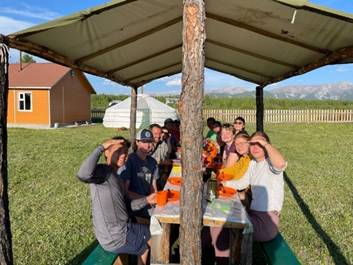
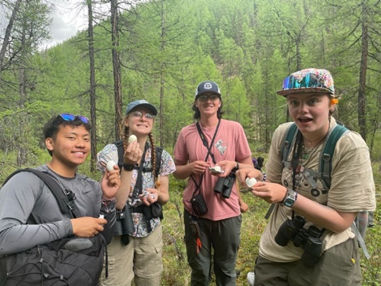
We came to realize quickly the next day that plans, and the calendar can change very quickly. We were supposed to start Pika research, but a few things came up in the process. Since our group was the first Round River group to come on June 15th instead of the 20th, we got to basecamp a few days ahead of schedule; therefore, the research would be conducted several days early, and it would not have matched the times that the research was conducted for the past several years. To ensure our Pika research would match previous years, we went on two-day hikes and a 3-day backpacking trip to retrieve most of our camera traps. Our first-day hike was to retrieve our first two cameras. Our group was quite big into singing songs that some of us knew from past experiences. The First camera we came across was set on a not-so-active game trail and did not capture many animals walking along the trail. For this reason, we relocated the camera to a more active trail and hid it enough so that it would not get stolen. Just about 100 meters from where we were setting the camera, Noelle and I were watching a hillside since Chris had said a Pika lived there, or so he thought. Pika is one of my favorite animals and one of many reasons for choosing the Mongolia program, I wanted just to sit and watch for a moment. From the top left of the hill, I saw a small Lagomorph running fast down the hill in our general direction. Noelle and I attracted more attention from the rest of the student group, all of us watching the Pika through Binoculars from the tree line. We then all ate our boiled eggs, thanks to Amka, who prepared them as a part of our lunch/snack while in the field. After a few minutes, we had to set off to our second and final camera for the day, which got a lot more action than the first, including a lot of boar and elk. We snacked and then headed back to basecamp, we traveled in a stream with hills on either side, and a storm was coming in fast. We all stopped and prepared for quite the storm, putting our electronics in our bags, getting raincoats on, and pack covers as well. The sky got dark, and it began to rain. It thundered and stormed heavily on us as we walked toward the Mongash River, which would take us most the way to base camp. Not only did it rain, but it began to hail and e were practically in a cloud in the mountains in Mongolia We didn’t let that stop us from enjoying nature and our time together; my one primary memory being Erin and Sophia singing songs together that they both knew. Bringing up, at least, my spirits and most likely others as well, while we hiked through the thunder surrounding us, hail coming straight down, and a dramatic drop in temperature that we would later find familiar. Though it may sound like a bad experience, along with one of our first impressions on the weather here, we all enjoyed it though everything was wet and cold. We came back to the ger where Badmaa had started the fire to warm us, we changed to dry clothing and we ate Amka’s cooking which was a perfectly timed dinner as we got back to basecamp.
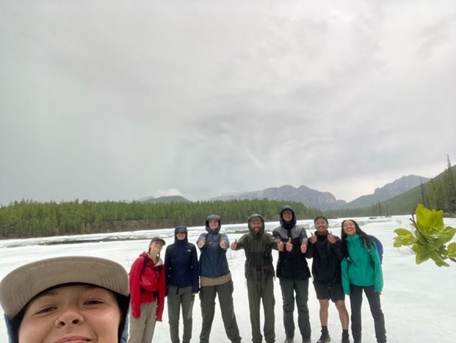
The next day we went out to retrieve four camera traps, it was going to be a long day for us all. We packed our daypacks and set off toward the Mongash River, which is still frozen enough to walk on safely. We decided that since we had extra cameras, there was an interest in setting a camera up to watch the ice of the river melt on a timelapse setting to retrieve in a few weeks when the ice breaks and melts. The cameras all went smoothly, and we captured boar, elk, moose, and other smaller mammals, including squirrels which Chris does not like for personal reasons. He told us that there was a camera trap he oversaw sorting an SD card, and a squirrel started stashing its cache in a stream bed, and all the pictures were mostly of the squirrel moving about in front of the camera, triggering it a lot. In the end, the squirrel’s cache of nuts and goodies was washed away by a flood in the stream bed; Chris told us it was the squirrel’s fault for stashing them in a waterbed in the first place. The final camera was at a higher elevation with an amazing view; many, including myself, had sore feet and a few forming blisters; we took our time, had snacks, filled our water bottles, and took in the amazing view of the mountains. Once we finally got back to camp, it had been a 20-mile day with quite a bit of elevation integrated in the hike; though we had many breaks and snacks, we were tired and sore from this long day. Grace led a group stretching session which was greatly appreciated by everyone! The next morning, we would all have the big decision, whether to start a three-day backpacking trip or if we wanted a rest day and then a backpack.
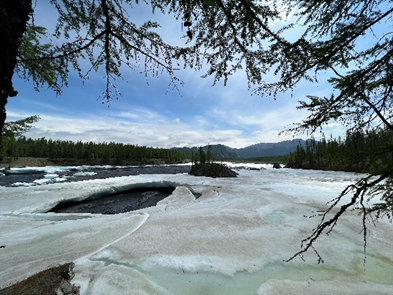
As a group, we all felt ready for the backpacking trip to commence and would much rather get it over with to have two days off to sort through the camera SD cards. We packed our packs and began our nine-mile hike toward camp for the next two nights. This was my third ever backpacking trip, and I was carrying a pack a little larger than I used to. Nevertheless, we retrieved two cameras before setting up camp. After getting a fire started, we all contributed to keeping the fire going and cooking dinner for the group, which the peanut Thai noodles were delicious and very filling. So much so that we finished the pot. Most of the group, other than Isolina, Suree, and I, went to bed for the night in preparation for another long day. The three of us stayed up a little later and shared college stories and talked around the campfire until around 10:00 PM that night. The next morning, two cameras were retrieved all together, and then we separated into two groups to cover more ground in one day. Noelle, Erin, Chris, and I went to set up a new camera in a valley, and the four of us found a boar rub on a tree near a nice trail and a stream, hoping that next year’s group gets some good action on the camera. We then ate lunch next to the stream and filled water bottles from the stream, which were cold and tasted great. Our second camera was hidden in a tree trunk which Chris did not inform us about but stood right next to as the three of us walked around this field of trees until we noticed him laughing, saying he had found it. Though he still did not inform us where it was as he wanted us to do it ourselves as a learning experience, being able to notice your surroundings in the wilderness is a very useful and always used skill in the field. The second trap was simple as we just had to switch the SD card with a new one. Though the third camera was a hassle, we experimented for around 45 minutes trying to get the right angle on the trail which was a little active but also not very good pictures of the animals using the trail. We came to realize that the camera was not working correctly on the trail it was located at. On the other side of the stream bed was a very commonly used trail by both species of wild animals and horse riders. Carefully we looked for a new location for the camera, and we finally found a downed tree upstream which had a good view of the trail but was also very hidden. Due to unforeseen circumstances, we returned to camp late, ate dinner, and went straight to bed since it was a long day.
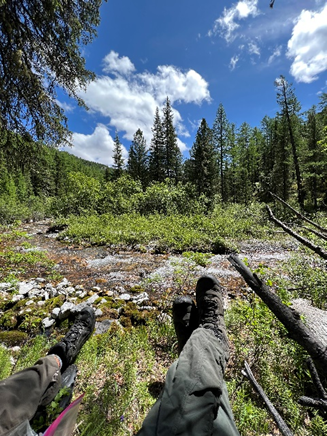
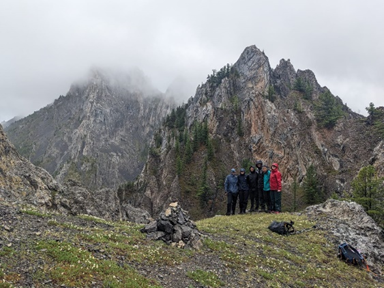
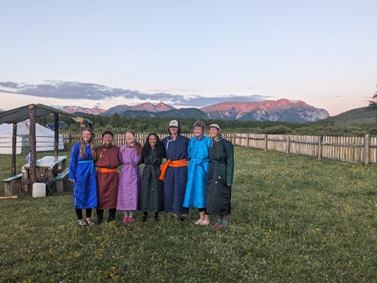
We headed back home and retrieved three camera SD cards on the way back, and it rained most of the day. We took a detour up to ‘The Notch’ to retrieve one of the cameras and see a new view of the Darhad and Horidol Saridag. The Notch in the mountains gave a beautiful view of the river and the mountains on the other side. Warm and dry clothes were very pleasing once back at camp, along with knowing we would have two days of rest and just academics with sorting through the SD cards on the computer. We went into Ulaan-Uul where the showers were warm, and washing dirty clothes was nice, along with being able to contact loved ones and post online about my experience here so far. We all bought new Deels were handmade for each of us and all beautiful and the best surprise we could have received after four very long days in the field. After showering and washing clothes, we all worked hard together after lunch to sort every SD card other than one that contained 9,000+ photos of species crossing the notch. I am highly looking forward to the rest of this once-in-a-lifetime experience that I will remember and the knowledge I will take with me after graduation.