
By Fiona Casey of Carleton College
Do you know the scene in Lord of the Rings where Strider determines Pippin and Mary’s fate after the battle? No? That’s okay. I hadn’t seen Lord of the Rings before our campsite movie screening (“pass the popcorn and pick up your feet there’s a parabuthus scorpion on the ground!”). In the scene, Strider supposedly reads the squashed grass and other clues among the detritus of battle and deduces the dwarves’ speed and direction. Our delta audience laughed. Such powers of tracking were not at all a stretch; “It’s Dix!” we cried.
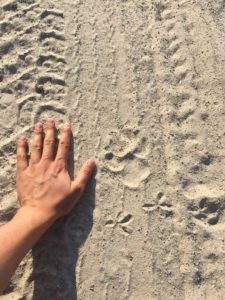
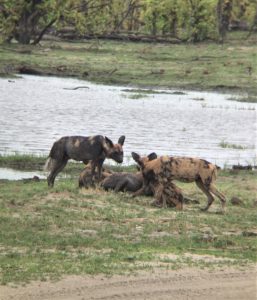
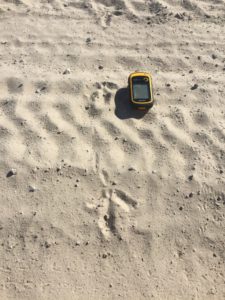
Our instructor, Dix, grew up in the Delta and has worked tracking wild dogs and other predators in the area for several years. He leads our natural history classes during which we get to explore the Delta on foot. The Delta is a prime location for tracking since the sandy, alluvial soil preserves details of tracks for days. The roads are particularly good places to look for tracks since many animals use them for travel and territory boundaries. On transect, Dix often has his head out the window scanning the road. At first the rest of us didn’t want to look down, afraid we’d miss something. We quickly learned better and can reliably be found with our heads out the window. It served us well in November, when my car picked up wild dog tracks and veered off our route to follow. We trailed them a kilometer down the road until they turned off into the brush. As we got ready to give up and turn around, a car approached from the opposite direction. Their driver had just left the other half of our group with a pack of wild dogs! Our tracking hadn’t led us to the dogs, but it got us close.
On natural history walks, Dix gives us time to brainstorm an explanation for a scene. The hard part is not jumping to conclusions based on the first mark we see. For example, when asked about a hole near some roots we guessed aardvark until Dix pointed out the elephant trunk marking near the top. Memorizing a track ID guide only gets you so far. If you’re learning a new language, the ID guide just gets you the vocabulary. The grammar and ability to string the sentences together comes with time. After a couple months on transect, we could begin to assemble the pieces, drawing from observations of animal behavior (though no amount of training or experience can bring us close to Dix’s perception!). In November, a piece of fresh scat covered in flies caught my attention. Only a carnivore’s poop attracts flies. Who’s was it? Small cat prints, two lobed with claws suggested a wild cat or caracal. It had been in the area after rain along with a group of impalas – and a baby impala! Off to the side there was a strange circle of leopard and baby impala tracks facing every direction. A month ago we may have been stumped, but it fit the behavior we witnessed in October: an impala had leapt in a circle to escape the hold of a leopard.
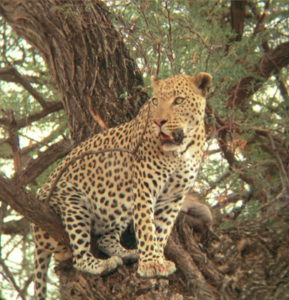
Tracking, mixed with a fair amount of chance, brought us incredible sightings. In December, we spotted a juvenile warthog trotting past us on its own. We slowed to see where it would go. A low guttural call like heavy staccato panting came from our right. We were not the only ones on the warthog’s trail! A male leopard loped in to our left, slowing as he approached the warthog, then sprinted. We chased after them, trying to find a route through the brush. When we caught up, the leopard had the warthog by the neck and was still in the process of strangling it. Once it became limp, he carried it to an upper branch of a camel thorn acacia. He started in slowly by removing the rough hair around the warthog’s neck. Then he tore off the left ear, taking care to catch every drop of blood. Finally, he opened the skull with a nerve-tingling crack! We watched for as long as the daylight lasted and got as far as the two front legs (both gnawed off and eaten completely).
Driving back, we marveled, replaying our chance encounter in our heads. What if we had not gotten out to look at that tree during transect? What if we had been going slower? The alternate possibilities were overwhelming; we could have so easily missed this once in a lifetime sighting! At the same time, however, we were riding in an all-terrain vehicle, driving around seeking out wildlife for 5 hours a day. It was lucky, but it wasn’t total chance. We had the privilege of time and money to devote to completing these transects. Now at the end of the semester, I am grateful to have had the opportunity to learn from our instructors how to track down and pursue opportunities, how to talk about the underlying supports and privileges that enable them, and to have enjoyed many moments of sheer, dumb luck together.