
by Jess Harkness, of University of Vermont
Botswana Student Program – Fall 2019 Semester
It’s almost midnight in Botswana, and we’ve been on the road for twelve hours straight. By “road”, I mean a well-traveled path in the sand through Chobe National Park. It’s been a bumpy ride, but I can’t complain- midterms are over, wild dogs are running next to the car, and the largest waterfall in the world is sitting just past the border of Zimbabwe.
Although the drive to Kasane seems endless, we eventually arrive at our campground. We stretch our legs, pitch our tents, and attempt to get some sleep in the October heat. The next morning, I wake up way too early (as per usual), and try to wash the dirt and sweat out of my clothes before the bustle of the day begins. After spending the morning playing card games, we make our way to a boat dock on the Chobe River. We’ve got a boat ride planned for this afternoon, a rare occasion where we can kick back and not count every herbivore we see. We climb into the boat and pull away from the dock as our captain explains that the Chobe River forms the boundary between Botswana and Namibia. When we look to the left, we are looking at Botswana, but when we look to the thick reeds on our right, we are looking at Namibia. I think to myself about how I am quite literally in two places at once; or maybe I am in neither place at all, depending how you look at it. There’s an island in the middle of the river that splits it into two channels, called Sedudu Island.
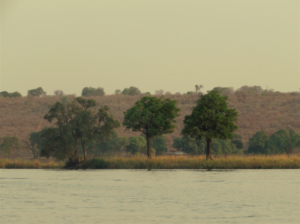
In the 90’s, Botswana and Namibia couldn’t decide which country Sedudu Island belonged to, so they took the matter to court. It was ruled that the country with the shallower channel would claim ownership of the island, and so the island officially belongs to Botswana. We make our way down the river, stopping to admire the buffaloes, crocodiles, hippos, impala, and water birds (my personal favorite). The sun begins to set on a pod of hippos, hanging around near the shallow banks of Sedudu Island.

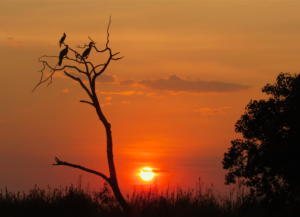
We watch our sun sink below the horizon, painting the sky as the water gently rocks our boat. It reminds me of those south Jersey sunsets that are so familiar to me, brief and brilliant, demanding to be admired. Our captain brings us back to the docks, and we head back to camp after finding dinner in Kasane. I know I should try to get a good night’s sleep- we’ve got big plans for tomorrow.
The next morning, a bus pulls into our campsite. For a moment, I’m a little confused. This bus is probably meant for some other campers- it’s been a while since we’ve driven in anything besides our trusty Round River vehicles, which we love even when we need to change their tires and dig them out of the sand. I eventually realize that the bus is our transportation to Victoria Falls, and we get to be real tourists for a day (air conditioning and all). We cross the border into Zimbabwe and arrive at the entrance to Victoria Falls, which, like so many other things, is named after a British monarch. However, the indigenous Lozi people of Zambia gave the Falls a different name: Mosi-oa-Tunya, meaning, “The Smoke That Thunders.” And thunder it does – I can hear the rushing water long before I can see it. The air becomes heavy with mist as the falls come into view, and my mind kind of goes blank.
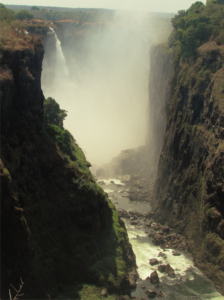
I am overcome with awe. I’m standing here on the edge of this giant scar in the earth, carved by thousands of years of relentless water, and I can’t really remember how I got here. How many things in my life had to happen, exactly the way that they happened, for me to cross paths with this place, nearly a whole spin around the world from where I grew up? My life feels like a blip compared to the life of this landscape. People always say that it’s a small world, but the world feels gigantic to me. There is so much space between where I used to be and where I am now. I feel very small, but also grateful to be here at all, even if just for one day.
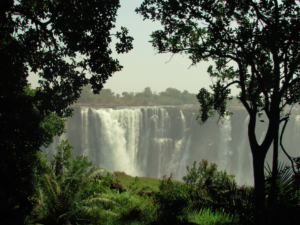
After walking around the falls for a few hours, the heat gets the better of us and we decide to call it quits. We begin our drive back to camp, and I doze off in my seat, thinking of rivers and waterfalls, but most of all, thinking of oceans. I picture my home on the other side of the Atlantic, and the people I love, hoping they will get to hold the beauty that I have seen today in their own eyes someday.
