
By Ayana Harscoet of Bowdoin College
We arrived at Marisol’s by truck on a cloudless afternoon, shaking a thick layer of dust off our packs (Anna had left the tailgate open, leaving them exposed to the dirt road). She found us laughing and dusty, and, taking one look at us, declared, “You must be my girls!” I had no idea what to expect when we’d received our homestay assignment, but any anxieties evaporated quickly, seeing this woman with a smile brighter than the flowers embroidered on her shirt.
She waved us through the gate, and we followed her through the sprawling front yard towards the house, tucked back from the road amid dozens of kinds of flowers. Flowers planted in boots, in car tires, Crocs, old toilets–anything that would hold a few handfuls of dirt. Cat, Anna, and I couldn’t stop grinning as we took it all in–we’d definitely gotten lucky. Even better news as Marisol welcomed us into her home: beds for all of us!
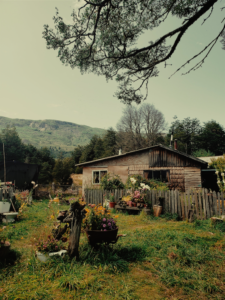
Leaving our bags in our temporary bedrooms, we sat down at the dining table and were introduced to Yara, Marisol’s 22-year-old daughter, and her husband, Nelson. Each of them welcomed us so warmly as we started on a late lunch, discussing the Round River program, the type of work we’d be doing, and Marisol’s adamant commitment to making this week a relaxing experience. No hard work here, she reassured us. As it turns out, those next few days were just that–some of the most peaceful, restorative, and grounding days i’ve experienced–maybe ever.
Back at base camp, it’s hard to talk about this week, and even more challenging to describe it in a blog post. I’m struggling to do justice to the depth of my experience without overly romanticizing my glimpse of a way of life that, at the end of the day, was just that–a glimpse. In some ways, though, i reallly did feel transported, as if I’d forgotten that anything existed beyond the world of the campo.
Each day followed the same loose schedule, framed by mealtimes and daylight and the 4am radio briefing. As Cat, Anna, and I slept, Marisol and Nelson would rise before dawn each morning to listen to the news–local at 4am, global at 6am. I was usually the last one up, finding everyone sitting around the kitchen stove, drinking mate, around 8:30 or 9. We would always sit and talk for a good half hour as Marisol passed the mate gourd, though some mornings this ritual was preceded by other tasks: milking the cows (planned) or tracking down an escaped cow by the river (unplanned). With Anna’s fluency in Spanish, we were able to have full conversations with the family as we transitioned to breakfast at the table, sharing their moments of laughter, however delayed, as Anna translated.
After breakfast came morning work, a different task every day: digging up and scrubbing the dirt from dozens of garlic bulbs, picking sweet plums for jam, replacing rotting fence posts, shoveling dirt and wheelbarrowing it back to the garden, and more. We often concluded by picking beans and peas for lunch, shelling them back at the table inside the house. Then we’d usually rest for a bit–read, journal, chat–as Marisol prepared lunch, though one day we helped her make dozens of gnocchi.
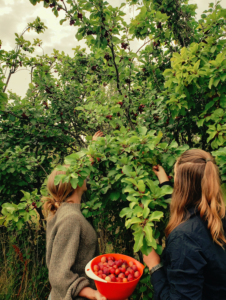
There were always little exceptions to meals that made each one different: one night, it was pancakes for dinner; another morning, she taught us how to make sopaipillas and her amazing, ever-present rolls of bread. Still another night, we had a mini-asado outside–a barbeque over an open fire, with lamb and chicken–with a small crowd of visitors who had all dropped by that day. The visitors also shaped each day: with no wifi or cell service, the family often received visitors with little to no notice at any time of day, welcoming them warmly and drinking mate together.
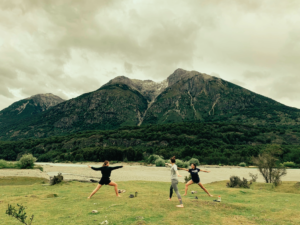
After lunch, around 2 or 2:30pm, we’d usually have a good two hours of siesta. The family napped, and we sometimes did the same, though I spent most of these hours reading, journaling, or walking down by the river across the road. Once, Yara joined Cat, Anna, and me in a session of riverside yoga, snowcapped mountains rising behind us.
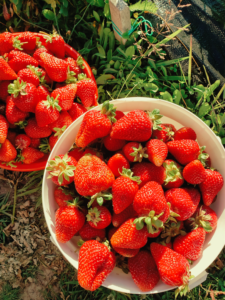
Following siesta, it was straight to the strawberry patch above the house: hundreds of strawberry plants, raised in neat rows covered by black tarp. First and foremost, Marisol’s campo was a strawberry farm, producing thousands of sweet red frutillas that were then bagged, weighed, and sold in town. Our job most days was to prune and weed the plants, and we worked down each row methodically, armed with nothing but a small pair of scissors. The last two days, we helped fill several large buckets with the ripest berries, for sale in Cochrane. Fresh strawberries accompanied many of our meals, and there was always a bowl to snack on in the kitchen–a good thing, since dinner usually happened at 8 or 9 in the evening.
After dinner, things would wind down quickly, and Marisol and Yara would often go to bed. Some nights, we’d stay up with Nelson, hearing his takes on Chilean politics, and I would do my best to follow along without translation. I definitely felt my Spanish improving over the week, and Marisol encouraged us constantly. On our last day, as she was teaching us to embroider, she said a few words to Cat, expecting Anna to translate. When Cat said that no, she’d understood, Marisol started laughing and gave her a huge hug. “I’m so proud!” she exclaimed.
It was with this warmth that we left the family after an idyllic week, tearing up as we hugged them goodbye. If all goes according to plan, we’ll see Marisol in two weeks for a group embroidery lesson at base camp. Until then, Cat, Anna, and I each have our own little tin of embroidery supplies–”homework”–to practice, stitching bright flowers into handkerchiefs: a long-lasting reminder of that sunny week.