By Patrick Heaton of University of Vermont
It is the rainy season here in the Okavango and the roads are slippery and unpredictable. Our trusty Land Cruisers try their hardest but sometimes the roads win. We are almost a month into the semester and we’ve been stuck in mud, sand, and puddles that have extended up to my waist. Tow ropes have been broken, tied, and reused. There is a special form of comradery when a vehicle is stuck. It is a specifically funny situation because there is no other option but to work together. We’ve made multiple friends and shared many moments while being stuck in the mud. As of late, I have been particularly unlucky and seem to be cursing vehicles into continually getting stuck. I am currently on a three-day streak of getting stuck. Each time is unique in its own way.
Day One: Every morning we leave for transect at 6:15. This particular morning the Cruiser I was in, Monna (every vehicle has a personalized name) was having battery troubles. After multiple attempts, we were able to jump the battery. We then headed to the main road where the different transect routes derive from. Being a wider road, the main road collects large, deep puddles. Most of these puddles are fairly passable as the dirt is more compact than less utilized roads. Unless it rains for three days straight, which was the case this day. One of the other Cruisers, Moana, went through a particularly large puddle with ease. Mona followed but did not experience the same result. Water came up past the tires and quickly spun out, spraying a layer of mud onto headrests, travel mugs and Rite in the Rain notebooks. Fortunately, this was a particularly uneventful case. With stable, dry dirt in front of the large puddle we were able to hook a tow rope up to Moana and she pulled us out with no extra help.
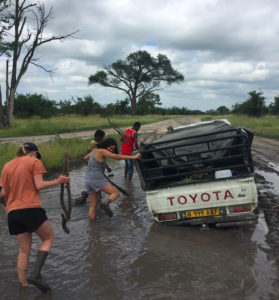
Day Two: My project this semester involves surveying grass species and collecting data on vegetation composition. Two of the three cars out for transect this day were to complete the first round of vegetation surveys. I was again in Mona, going to transect #2 to work on the surveying. We arrive to the route with no trouble and completed our first survey at the start of the transect. Surveys are performed every two kilometers, and within the first kilometer of transect we came across a pool of mud. From the outside, this seemed like a simple pool to cross as we had already gone through much larger. Although the mud can sometimes be much deeper than it looks. We sunk quickly and spun out once again. This time we were alone. First, we tried to dig out the wheels, and place branches under them for traction. Standing waist deep in mud and digging under tires is a slow process. We pushed multiple times with no luck, the mud was too deep. Luckily, since we were only one kilometer into the transect we were still very close to Mababe, the village we had been staying in. Some people over heard our engine revving and tires spinning and came to our rescue. We retied our broken tow rope, (it broke while helping a large safari vehicle out of the mud a few days earlier) hooked it up to our rescue truck, and were pulled out. We left behind large divots from our spinning tires that filled over with water, making the pool look shallow and harmless once again.
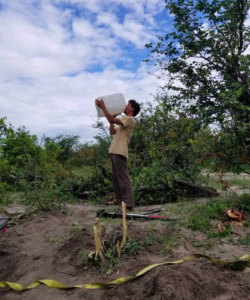
Day Three: We were headed to transect #7, the furthest transect in the Mababe region. I was in Monna for a third time. This required a two-hour drive to reach the trailhead of this route. We passed through grassland, scrubland, and Mopane woodland. Mopane is a very common species of tree here. The woodland stands seemed to get thicker the deeper in we drove. This came to an abrupt realization as we suddenly became wedged between two Mopane trees, unable to move. In this case the woodland consisted of very soft, sandy soil. It seemed the harder we tried to become unstuck, the deeper our tires cut into the sand. We pushed, pulled, and dug but were unsuccessful in all attempts. This put our GPS skills to test as we had to make a waypoint of our location to be found by Moana. After waiting a bit, we were found and went to work. With a lot more digging, another broken tow rope, and restarting a battery we finally got Monna out of the seemingly quicksand we had gotten into. We drove back to camp with quite the story for campfire.
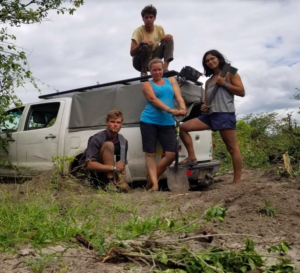
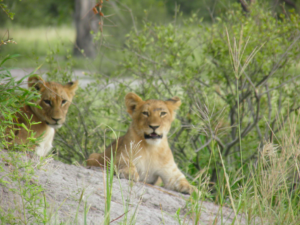
Each day here in the bush seems to get more unpredictable. Some days you might watch lions rest at sunset for hours while others you dig out tires in endless mud. But with the right preparation and attitudes it feels like we can take anything that comes our way. One thing for certain is that there will be stories to tell regardless. There has not been a dull moment yet.