
by Christine Fleming of the University of Vermont
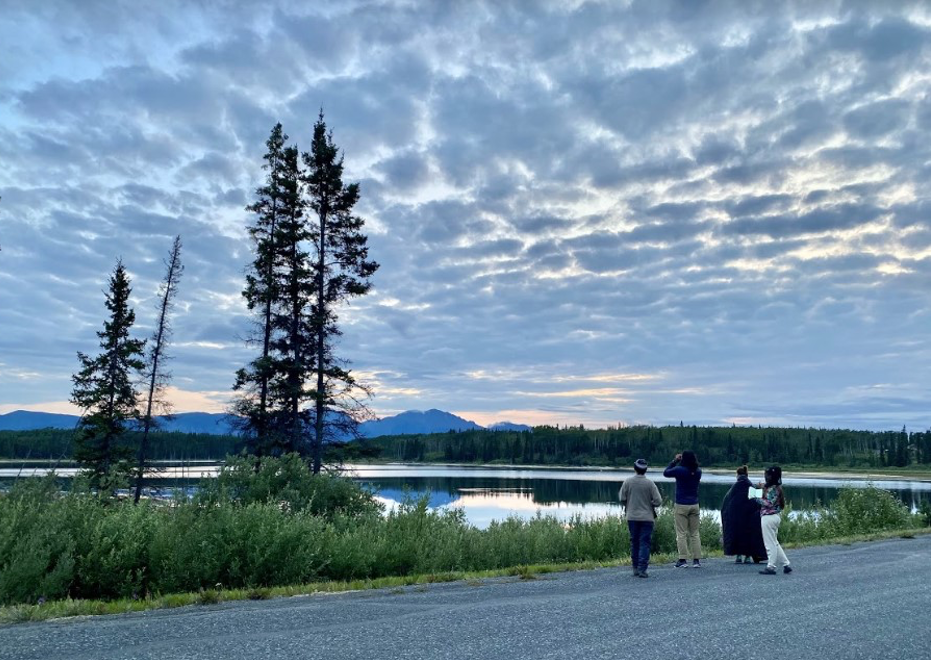
At around 10pm on July 13th, we loaded into our two dirt-covered pickup trucks for the latest round of wildlife monitoring. With thermoses of hot tea in our hands and music blasting through the speakers, we drove past dense spruce-fir forests and glassy lakes reflecting the setting sun. Finally, we arrived at our first destination, an otherwise arbitrary point by the side of the road. Our goal: To find evidence of common nighthawks (Chordeiles minor).
The common nighthawk is an insect-eating bird that is most active at dusk. Nighthawks typically fly in high circles to catch insects, making their characteristic, nasal-sounding meep meep call. Occasionally, males will swoop down in such a way that the wind blowing through their wings makes a loud “wing-boom,” which sounds sort of like a train horn. The first time I heard a nighthawk wing-boom, I thought it actually was a train horn. Then I remembered there aren’t any trains around here.
For our surveys, we stopped at ten designated points on the side of a road, each roughly a kilometer and a half apart. At each point, we would stand motionless for six minutes, listening for meeps and wing-booms. This behavior was concerning to passing drivers, who would occasionally stop to ask us if we were okay. We replied that we were looking for birds, and the drivers would shrug and continue on.
After the first few survey points, we still hadn’t seen any nighthawks. We heard an owl, various songbirds, and plenty of mosquitoes, but no meeps or wing-booms. The night was getting cold, and it was past midnight. We were running out of tea.
Then, at survey point 7, a nighthawk flew overhead! There was some doubt over whether it was actually a nighthawk, since it was flying awfully low for a nighthawk and looked vaguely bat-shaped. But when we heard a wing-boom from the direction the winged creature flew, we decided it was a nighthawk after all. Current count: One! We drove on.
We only ended up seeing that one nighthawk that night, which is fine! The goal for these surveys is not to count the highest number of nighthawks (although that would be pretty cool if we did find a lot) but to determine where nighthawks are, and where they aren’t. We have a saying that “even no data is good data,” meaning that even if we don’t see any of the species we’re searching for, it’s still valuable to the Taku River Tlingit and other interested parties to know they aren’t there.
We finally finished our surveys at around 1 am. We drove back to our base camp in the darkness of the night, falling asleep to the music blasting through the speakers.
References:
Campbell, W., Kennedy, G., Kagume, K., & Adams, C. (2005). Compact guide to British Columbia birds. Lone Pine Publishing.