
by Leah Israel of the University of Vermont
A symphony of names floods my head in many languages. This tree is called Mopane to some, Colophospermum mopane to others, and some might simply call her The Elephant Ear Tree. The leaves of this tree are in fact shaped like two elongated ears resembling those of an elephant. I see her and I smile in greeting because she is not a stranger, I know her many names.
I acknowledge the soils which consist predominantly of clays as preferred by the Mopane. I also notice that the occasional Motsweketsane – Knobbly Combretum to some – will appear among the Mopane community as these two thrive together.
The Phiri goes by many names. Most researchers call her Crocuta Crocuta, whilst others will know her by the name of Hyena. Others still know her simply as “Phiri”. She walks through the Mopane scrub and turns her head to eye us curiously. Her disinterest in our presence sends her on her way, perhaps to find the carcass of the elephant, Tlou, to scavenge.
My perspective of the world changes immensely when I know the names of those around me. They are no longer a stranger to me and thus, I am no longer a stranger to them. There is an intimacy that arises when you know who you are observing and who is observing you. As the month has progressed, I find that my understanding of the landscape around me has transformed dramatically. I can name the grasses, the trees, the birds, the mammals, the river. I walk into a Mopane woodland and am always pleasantly surprised at how safe I feel among the brush. When I know the names of those around me, I am never alone.
Spending time here among the biota with whom I share my new home has fueled my desire to know the names of everything around me. I am constantly tuned into my surroundings, hyperaware of all of the strangers around me and the names I have yet to learn. Imbued in a name is a sense of identity. She is Phuduhudu; she is Steenbok.
Leina la gago ke mang? What can I call you? After “dumela”, this is often the first question I ask a stranger. I often get an amused smile, sometimes a polite chuckle in response to my poor pronunciation of the Setswana phrase. People here have been patient with me as I challenge myself to learn Setswana phrases as well as the many names assigned to the biota around me.
Ivy works at the Pull-in Investment snack stand and greets us with a smile upon our arrival. Nalede, which means Star in Setswana, will be waiting at the stand a little way down the road. We will approach and she smiles and exclaims “Hello Naledi!” which is my assigned Setswana name. At Maun, I pass Bentu and he exclaims, “O tsogile jang mma?” – How are you ma’am? – To which I reply, “Ke tsogile sentle rra!” – I am well sir. In Mababe, System and I are staring at a woody shrub. He turns to me with a mischievous smile, “Leah! What is this?” I observe the plant, notice she has curved branching with simple leaves and I say, “Knobbly combretum, System” and he does a humorous dance of approval.
I am a stranger living in the home of another. It is our responsibility as a guest to know who is welcoming us into their home. System, Nalede, Ivy, Bentu will all forget me long after I’m gone, but I will never forget them and their acceptance of me into their home.
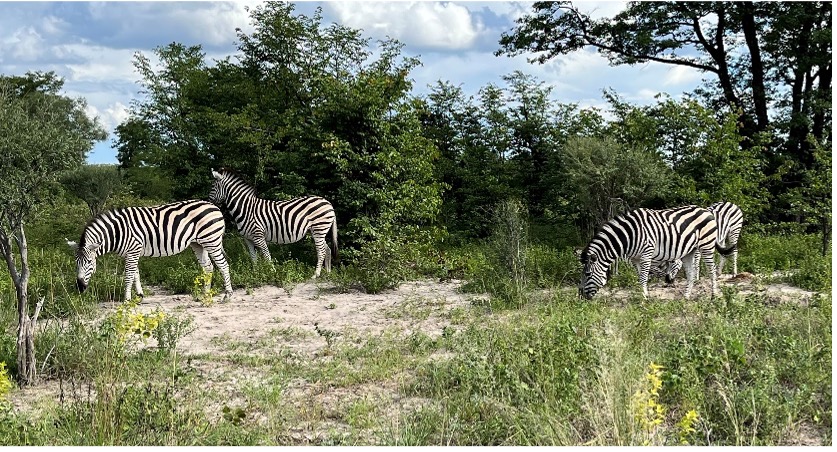
The same goes for the flora and fauna. They don’t know my name, but I know theirs and that is enough so I can properly thank them. “Ke a leboga, Pitse” -Thank you, zebra. By addressing them by name, I acknowledge their value as more than a number on my data sheet.
It was difficult saying goodbye to Mababe and the people we met there. I aspire to build relationships like these the rest of my life; the relationships that make it hard to say goodbye.
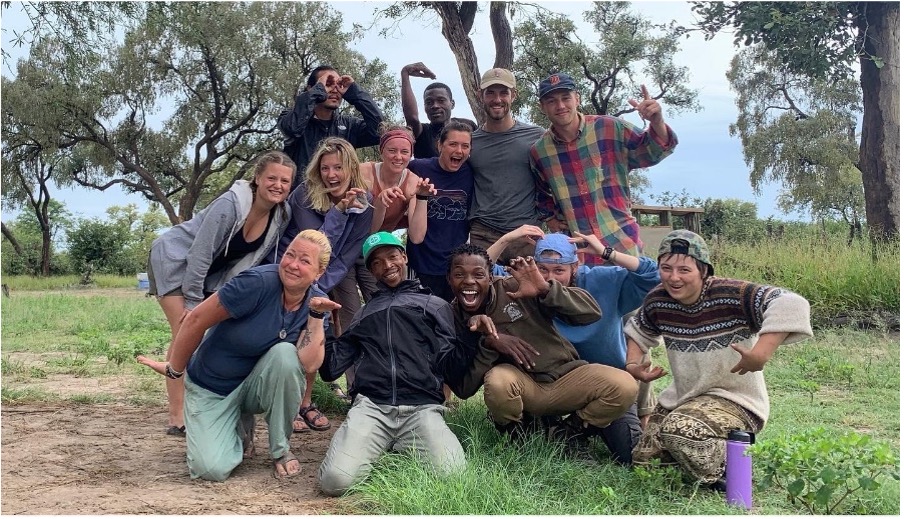
I was told 8 students would partake in this adventure. I soon learned their names and day by day I learn their stories. I am so lucky to experience the wonders of my current home with such an incredible group of people that have so much to offer to the world.
In casual conversation, environmentalists often suggest that humans are the cause of the world’s eventual demise. This is said with both a bit of humor and a devastating air of truth. We are an invasive species that consumes natural resources at a rate that threatens the integrity of the biosphere. We are destroying our own home and our neighbors along with it. And in knowing the names of those we might lose, we are that much more determined to save them. There is a responsibility that comes with learning someone’s name. I know you and thus, you matter to me.
The notion that humans are primarily to blame for the degradation of the Earth might hold truths, however leads many to see conservation and human existence as mutually exclusive. Humans are shunted out of the equation as national parks are established to keep people out and keep animals in.
Often in our pursuit of saving what is left of this world, we forget about humans. When we forget the names of anyone, we forget the names of all. When we forget who is the African Buffalo, we forget who is the lion because the lion relies on the African Buffalo as a food source. When we forget that humans are an inextricable part of this world, we are leaving out a significant piece of the puzzle. When we ignore humans, we lose millions of potential stewards for conservation.
It is no accident that the most oppressed peoples experience the most environmental distress (i.e. polluted air and water, urban heat effect, inaccessibility of healthy food and natural spaces, etc.). Often we are so focused on our day to day lives that numbers mean little to us. The quantity of people suffering does not matter. We hear again and again the statistics of people suffering from poverty, gun violence and environmental stressors. Yet, whether this number was 20 people or a million, our response is the same because it is still just a number. But then we hear a name we recognize and a face we know and suddenly these issues become real. By knowing that person’s name, you have a responsibility to them. You acknowledge their existence and their worth. Once we can finally see people, flora, and fauna as worthy of living, we would do more to save them and ourselves as a species.
Leina la gago ke mang? What are you called? Who are you? I care to know you and I want you to know me. In my opinion, this is the only way we can succeed in improving the quality of life for people while simultaneously improving the health of our fragile world.
I know your name, and thus you are important to me.
Ke a leboga anduntil next time,
Leah