
by Selma Siekert – University of Vermont
The morning brings with it early rising and breakfast – an array of granola, bran-flakes, Weetabix, and an abundance of peanut butter. In the young hours of the day, students gather together metal bowls, plates, cups, and assorted cutlery. All are quickly freed from the thin layer of soil that seems to find them no matter the storage location, and are packed into a cardboard box to travel to the Okavango Research Institute (ORI).
The plans quickly change, as plans so often do. Life is adaptability and balance! A broken down car, Duke, means that the two-day training will be attended by five students the first day, and the other four the second. The students left behind at camp are given camp duties, cleaning and sorting, to generally benefit camp life. They are otherwise left to read for upcoming classes, work on long-standing projects, and enjoy the sunshine.
The two-day computer training happens at ORI (when referred to, pronounced as “Ory”). Community members are invited to attend the sessions held in the building’s computer lab, its windows peering out to the beautiful, sunlit, nearby trees.
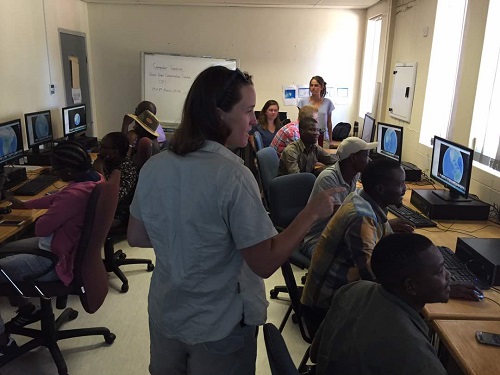
Kaggie shows her new students how to navigate Google Earth.
Day 1 is attended by six individuals, and focusses on Excel and Word. Day 2 is attended by eight, and focusses on Google Earth, GPS’, and any other potential questions. Samara, Kaggie, and Ged, three of the Round River Botswana program leaders, use a front-facing projector to provide visual context for their instruction. The community members, among which include Escort Guides from the Khwai Community Trust and researchers from the DWNP (Department of Wildlife and National Parks in Botswana), sit at computers and follow along. Students float throughout the room, assisting with any questions that arise.
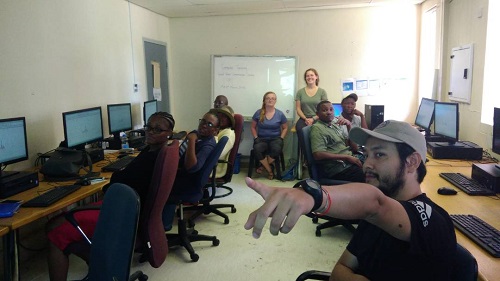
Ged teaches the basics of Word and Excel.
A lunch break is taken outside mid-day. The students go first to lay out the supplies gathered earlier that morning. The food is brought by local BP Restaurant. The array, different on each day, offers chicken, chopped carrots, beets, fluffy bread, and pasta. Everybody finds a spot in the sunshine to eat. Taste-buds are satisfied, tummies are filled, and students wash and put away the plates once more.
After lunch the training continues. Excel short-cuts are divulged. GPS coordinates are uploaded into Google Earth, and research transect runs are plotted on satellite-drawn images. The roads of Maun are travelled from the rolling chairs in the computer lab.
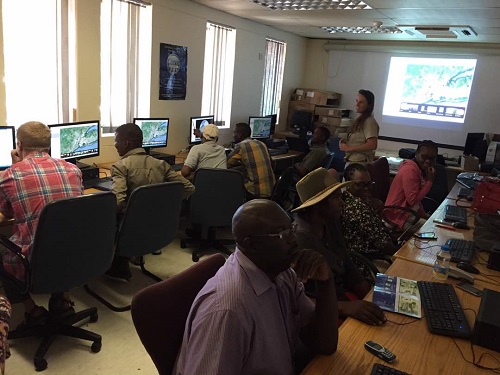
Escort guides loaded GPS points from their concessions into Google Earth and saw the tracks we drove together last month.
The training days bring with them positivity and exposure. Access to the computers, internet, and applications allows for practice in computer techniques important for wildlife and conservation related work. Researchers bring data for analysis and field leaders track distances of transect lines. Community relationships grow: the human beings in the room share laughter and understanding. Pathways to communication open: the instructors leave their emails and community members exchange contact information.
In the two days of training, human connection grows.
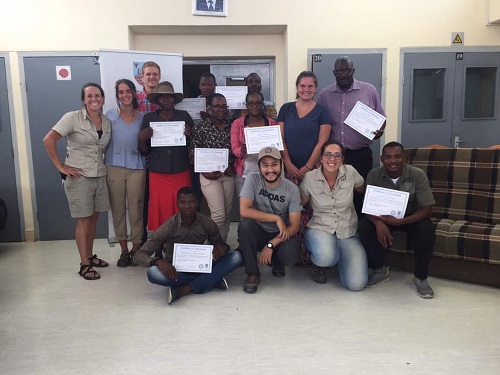
Instructors, students and their brand new certificates.