By Anna Bosco of Oberlin College
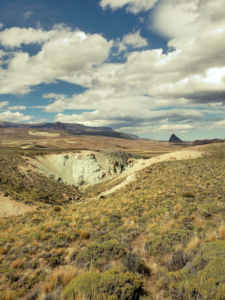
When I think of Patagonia, one of the first images that comes to mind is that of vast, hilly expanses covered in neneo bushes. Neneo (Mulinum spinosum), a medium-sized cushion plant, dominates the arid Patagonian steppe landscape. It grows in bushes roughly 0.2 – 1.4 m tall, and up to 0.5 m in diameter. Its cushion-like shape, which in Spanish is referred to as cojines redondeados, is characterized by a pale green color with small, yellow, five-petaled flowers on the ‘cushion’ surface. Simply by looking at its surface, you could never tell that the entire bush is made up of thick, intertwining thorns. Although referred to as thorns, these painful spikes are actually dried-up leaves, which grow in groups of three points, hidden behind a layer of green leaves and yellow flowers. Neneo usually flowers at the end of Spring in late November and December, and this is when the leaves tend to become dry and strong, acting as thorns.
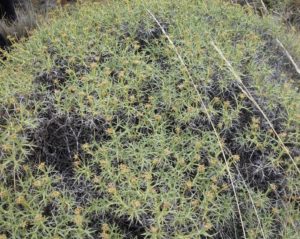
A characteristic species of the Patagonian steppe, neneo is found in places fully exposed to the sun, either on level land or on north-facing slopes. Its cushion shape serves as an adaptation to the extreme environment in which it grows – it protects against desiccation, erosion, and/or cold temperatures. Both teams Truco and Mate spent 10 days together on the Patagonian steppe in Chacabuco Valley, a 200,000-acre preserve just north of Cochrane. Neneo bushes were present throughout the valley, and we were constantly avoiding the spiky bushes as we conducted our guanaco population surveys and assisted in fence removal in that time.
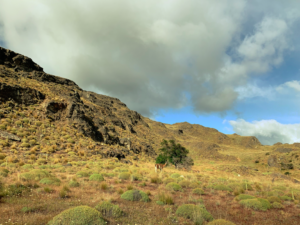
The dry, windy climate and harsh, cold nights that we experienced and occasionally struggled with while in Chacabuco is exactly the environment that neneo thrives in. That, and the protections placed on thousands of acres of steppe across Patagonia, contributes to neneo’s abundance and therefore almost nonexistent conservation concern.
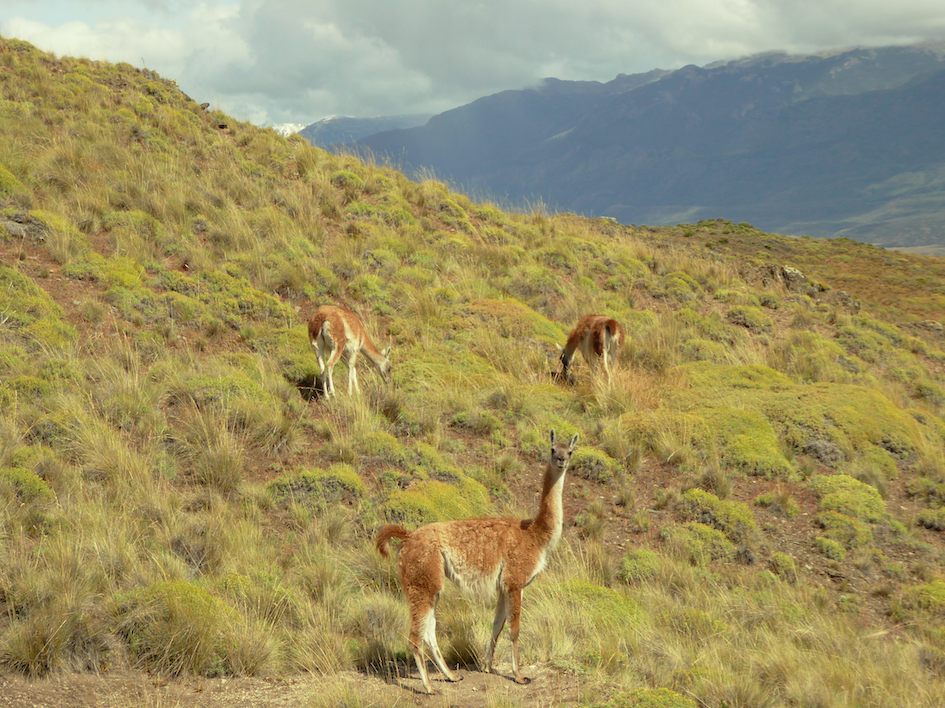
Not only an adaptive characteristic, neneo’s cushion shape creates a unique microclimate, providing a buffer against external conditions, establishing it as its own habitat for many smaller species. Additionally, many herbivores graze on neneo flowers, including guanaco and sheep (and the occasional goat). Historically, steppe environments including Chacabuco Valley have been used as grazing land for domestic sheep, resulting in neneo-rich diets in much of Patagonia’s lamb. However, neneo consumption gives the meat of the animal eating it a strong flavor unpalatable to humans, resulting in steep revenue losses for ranchers. To avoid such problems, ranchers have taken to isolating their herds in neneo-free wetlands in the days prior to slaughter so as to remove that undesirable neneo taste.
To me, Mulinum spinosum is one of those iconic plants that takes you to a specific place and time. Found only in the Patagonian steppe of Chile and Argentina, to be surrounded by neneo is to know you’re in a beautiful, crazy landscape unlike anywhere else in the world. Now that we’ve been back home from Chile for almost a month, I would give anything to accidentally step into a painfully spiky neneo bush; it’d mean I’d be back in the most lovely and magical place in the world.