
By Meg Hall of University of Vermont
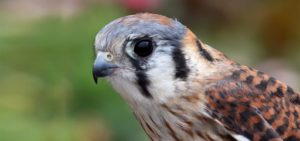
As Gabe and I drove across Chacabuco Valley for a guanaco transect, he spotted many birds; from Andean condors (Vultur gryphus) to juvenile black-chested buzzard eagles (Geranoaetus melanoleucus). He pulled the truck over so we could get a better look at them and he could take some breathtaking pictures. Gabe seemed to know more about these birds than the guidebooks that sat between us. On our way back to our base camp at Alto Valle, we spotted a bird hovering 10 meters above the ground reminiscent of a hummingbird. Gabe quickly identified it as an American kestrel (Falco sparverius) due to this characteristic flight pattern. As I looked out the window at the bird that bobbed in place in the air, he grabbed one of the guidebooks and quickly flipped to a page. He handed the book to me while explaining this unique hovering ability. I looked down to the book in my lap to quickly read about this species, and when I looked up again, the bird was gone. Gabe put the truck in drive, and we were again bouncing along the dirt road that cut through the center of the valley.
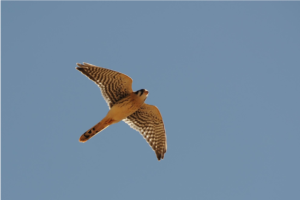
The American kestrel (or Cernícalo, in spanish) has one of the most widespread populations in the Americas — it can be found from Alaska to Patagonia. This species is also one of the smallest falcons with a length of only 10.5 inches (26.67 centimeters) and a wingspan of 23 inches (58.42 centimeters). The male kestrel can be easily identified by the slate-blue head (as seen in the image above) and wings and the rufous-colored body. The females also have the characteristic slate-blue crown and rufous colored body, but no blue in the wings. While flying, individuals can be identified by the long and slender classic falcon body shape with slim and pointed wings (as seen in the image above). There are over a million individuals, so the American kestrel is classified as a species of least concern in conservation efforts according to the IUCN Red List.
This species often prefers habitats that are open with lower vegetation, such as the steppe where RRCS has seen many individuals, but can be found in a wide variety of ecosystems as long as there is an adequate prey supply. Some individuals are even found in cities or suburbs throughout the United States. They prefer open landscapes due to their diet which consists of mainly insects and other invertebrates and occasionally small rodents or birds. The low vegetation and open space makes spotting prey and hunting easier. Kestrels can be seen hovering above the ground while hunting, which is a unique ability. Although this behavior can be used to hunt, often individuals will remain on a perch such as a high tree branch before swooping down to grab prey with one or both feet.
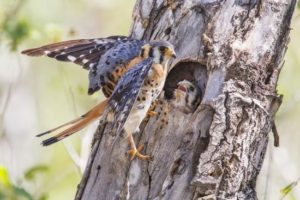
Along with hovering, males have been recorded portraying courtship displays to attract a mate. Males will fly high, call to the female who is flying slowly below and then diving down. A pair is usually monogamous for life. Once a pair has mated, a nest is made in the cavity of a tree (as seen in the image below) where 4-5 eggs are incubated by both parents for 26-32 days. During breeding season, American kestrels are known to be territorial. Instances of a male kestrel attacking other large birds of prey during this time of year have been documented and seen by some Round River staff.
Within an ecosystem, American kestrels can interact with many different species. Due to their small size, larger raptors are the main predator, but other mammals such as coyotes and raccoons pose a threat. The keen eyesight of adults helps avoid predation. The eggs and chicks are at a higher risk for being predated on. Although Round River did not study this species during my semester in Patagonia, I will always remember the feeling of awe as I watched a falcon hover like a hummingbird. The American kestrel, although small, packs quite a personality and everyone should keep an eye out for the little falcon.