
Rob McManus of CSBSJU
Two of the most prevalent things you can find almost anywhere in Patagonia are spikes and condors. During the moments we were not looking down at the ground trying to avoid the thorny neneo (Mullinum spinosum) or buzzy burs (Acaena magallanica), we could look up to the sky and constantly see the condors’ rectangular outline contrasting against the clear, blue, Patagonian sky. The Andean Condor or Cóndor (Vultur gryphus) is the largest flying bird in the world with wingspans as large as 3.3 m (10ft. 10 in.) and a maximum weight of 15 kg (33 lbs.). They are also one of the oldest living birds in the world and can live for 50 years in the wild and up to 80 in captivity. We were taught to easily identify them in flight by looking for an all-black body and rectangular wings with “fingers” sticking out of their ends. These “fingers” are called a bird’s primary feathers and they are responsible for steering and thrust during flight. Other key identifying characteristics of the condor include a completely bald head, white feather collar around the neck, and white feathers on the topside of the wing which are practically invisible when observing the condor from the ground.
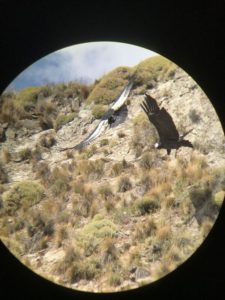
The condor has a wide distribution and can be found throughout the west coast of almost all of South America: particularly within the Andes mountain range. They prefer to inhabit grasslands and alpine areas and can be found as far north as Venezuela and as south as southern Chile. When traversing through BNP El Mosco, near Villa O’Higgins, we were able to observe many condor nests which were on rocky cliffs, inaccessible to almost any flightless organism. While adult condors have no natural predators, their eggs are vulnerable. Nesting on cliffs prevents egg predation and produces a safe environment for their young. We witnessed condors fly off their nests and begin to characteristically hover over the valley. Instead of expending energy flapping their wings to keep them aloft, they utilize thermal upwelling air currents to allow themselves to remain suspended in the air indefinitely when searching for food.
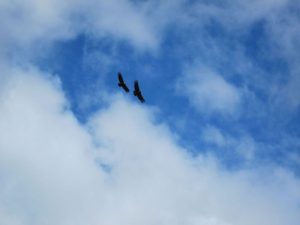
The Andean Condor is a scavenger and eats carrion – the decaying flesh of dead animals – which it is able to find with its excellent eyesight. It either locates prey itself or through a mutualistic relationship with turkey and black vultures. The vultures can detect prey by smell and will circle above them, what the condor can use as a clue for the location of its next meal. While the condor is not a strong bird, its hooked beak allows it to pierce through its meals’ tough hide which most other bird species cannot do. Once the condor is finished eating, it allows the vultures to clean up the scraps from the now opened carcass. A fun fact about the condor is their bald heads are evolved for sanitary purposes. After they feast on rotting flesh, they can fly high up into the sky and have their face sanitized by the sun’s UV radiation.
Male condors must present a courtship dance for the female for her to decide if he is an acceptable mate. If successful, the female will lay one egg per breeding period. The Andean condor young will leave its nest after two years of parental care but will not reach sexual maturity until it is six years old. As a result of the relatively low frequency of large prey such as guanaco (lama guanicoe) and huemul (Hippocamelus bisulcus) dying, condors may have to travel up to 200 km (120 mi.) daily in search of food. Their travel habits make them very visible from the ground and is primarily why we saw them within Chacabuco Valley, the steppe land of Predio Militar, south in Villa O’Higgins, and even at basecamp. At every sighting, I was always amazed by their size and grace when floating through the sky
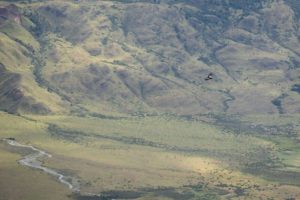
Andean condors are currently listed by the IUCN as near threatened but they are not a major conservation concern. This is partially a result of the pride and interest of Chile and many South American countries towards their conservation. To many southern countries, the condor is a national symbol for power, and they depict them on their flags and coat of arms: as the United States does with the Bald Eagle. However, as a result of habitat and species loss, condors have been switching their diets to dead cattle. Some ranchers falsely perceive them as a predator to their cattle and will either shoot them or poison a carcass which subsequently poisons the condors. Overall, these birds are not currently a major conservation concern and it makes me happy to know, with proper species management, they will likely still be soaring the Patagonian skies when I return.
Further Reading and References:
San Diego Zoo:
https://animals.sandiegozoo.org/animals/andean-condor
Peregrine Fund:
https://peregrinefund.org/explore-raptors-species/vultures/andean-condor
Animal Diversity Web: