
By Maddy Love of the University of Vermont
Mo here, coming at you from basecamp with quite the story to tell about a band of fools that took on the greatest adventure of them all, collecting data for the Campesinos research project. I probably should introduce you to the crew before it starts to get crazy. First, we have Jerry, birth given name: Jose Cruz. Jerry is known by his peers as a fishing connoisseur, hacky sack fanatic, worm lover and can be found behind the wheel of Blanquita. Next, we have Garry, birth given name: Garret Weichel. Garry loves talking about fire, how he’s from Montana and country music. Garry is a recent owner of a Mate cup which was an important factor of keeping spirits high. Followed by, Kenny, birth given name: Kendall Muzzy. Kenny loves bagging peaks, taking names, and sporting a smile no matter what. Kenny has recently found out that she runs cold and is always wearing all her layers when going to bed. Last, we have me, Mo, birth given name: Maddy Love. I can be found always wearing brown, a hat, and a bandana around my neck. I’m most known for being gluten and dairy free (a joke that never gets old between everyone), and no, it’s not to get attention.
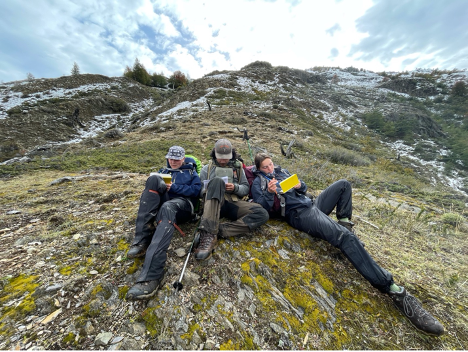
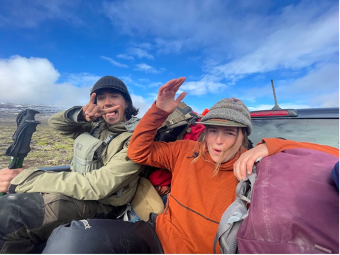
Now, let’s begin! We started our day a little late, so Jerry decided it was best for us to hitch a ride with one of the other groups to give us more time. This drive lasted two minutes as our point was only 800m from basecamp, but it was long enough for us to listen to Cowpoke by Colter Wall (one of Garry’s favorites) as we bounced around in the bed of the truck. Now, I probably should share the reason for our great adventure before I go any further. The goal of the Campesinos research project was to one, determine the presence of the Huemul and Puma population and two, understand the habitats which made up the landscape. We conducted our fieldwork in Lago Brown on Atilio Pizzaro’s land which consisted of a vast 3,000 hectares. Our overall trip was five full days, three days of day hikes and car camping, and two days of backpacking (and one very cold night).
Once we made it to our starting point, Garry took the responsibility of being GPS master and Kenny, Jerry, and I collecting data. Our goal of the day was to set up a camera trap and drop habitat points on the GPS all while backpacking to our campsite which entailed summitting a 1,400m mountain. Nothing Jerry, Garry, Kenny, and Mo couldn’t do. As we made our way up we looked for any signs of Huemul or Puma which consisted of sight, scat, tracks, and others such as evidence of antler rubs on a tree. The slope and snow depth increased as we gained elevation but spirits were high as we had all been missing the winter snow at home. Jerry, Gerry, and myself were all using poles, while Kenny was off her rocker and decided to be a no-pole Larry. As it reached near two, we decided to stop for a well needed lunch break.
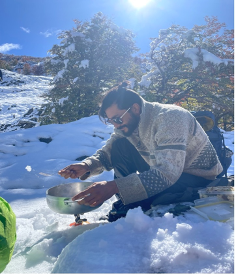
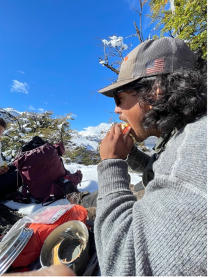
Now, lunch is no joke around here. Almost every lunch is the best lunch you’ve ever had when you’re in the backcountry. There’s truly nothing like the sound of opening up a new can of tuna after you’ve been hiking with 35 lbs. on your back for many kilometers. While I’ve been learning about how to be a conservationist, I’ve also learned how to make the best tuna. After you’ve drained out the water (into a hole; LNT) from the can, you drop your tuna into your bowl. Next, the condiments. You always have to make sure you have the right consistency of mayo to aji (Chilean sriracha) and just a dollop of mustard. Then comes the crafting, a moment where many take their own path. Most choose bread and add cheese, salami (sorry vegetarians), and cucumbers while few (just me) throw it into a bowl with cucumbers and tomatoes (no bread? No problem.). And every now and then you will have those who choose to eat leftovers from the pasts nights dinner and even fewer (just Jerry) take the time to heat it up. Dessert is always a pb and j because there’s nothing a spoonful of peanut butter can’t do.
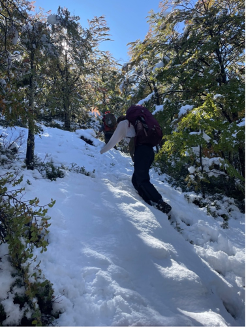
After the best lunch ever, we headed…..up…..straight up. With not enough time for our tuna to settle, the terrain quickly increased to a 35% slope. Luckily, we were surrounded by the lovely, native Lenga (Nothofagus antarctica) trees. The lengas allowed for something to grab on as we continued up. The next hour consisted of trusting your balance and sendin er up. After a steep climb we reached our camera trap site and set it up. To make sure we angled it correctly, Garry and I pretended to be puma running through the area. Since we are the best group that has ever been created in Round River history, we set it up correctly first try. Once again, we packed up our things and got back to our hiking groove. Soon after, 4 pm creeped around as we found ourselves at the base of what was in between us and our campsite, the peak. We assessed the best way to go up and then started trudging. By now, the snow was around two feet and the slope still ~30% so we had to be smart about where and how we took every step. Jerry led followed by Garry, Kenny, and me in the back with a small newfound fear of heights (thanks dad for that one). Within 30 minutes of climbing the snow had reached our hips, leading us to decided that we wouldn’t be able to make it to our campsite before sundown.
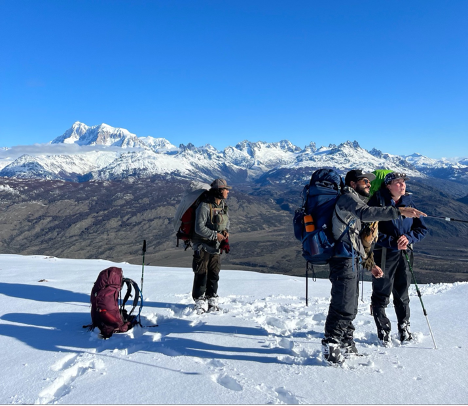
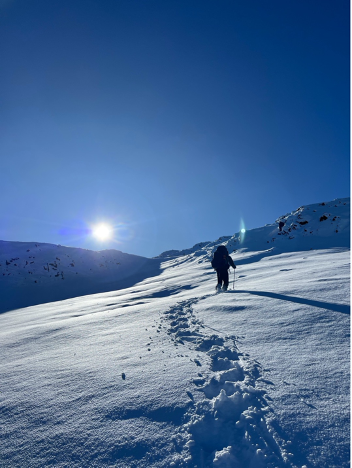
With our new plan we followed our footsteps down and down, trying not to slip in the deep snow. At one point Garry quoted it as being, “wet and wild”. After 2km of hiking we arrived at a spot that would be our home for the night. We set up our tents, rain flys fully soaked from the morning rainfall and put on all our layers. A fire was then set up by Garry and Jerry while Kenny and I cooked up what would be the best dinner ever – or at least for the moment we were in. We ate our dinner cuddled up next to the fire with the conversation topic of whether or not we should stay and start a settlement. Not long after, we crawled into our sleeping bags with dry socks on, Harry Potter in hand and Nalgene’s full of hot water to keep us warm.
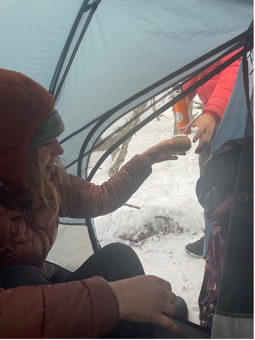
The next morning, I climbed out of my tent and walked to a lookout right near our campsite and watched the sunrise. San Lorenzo was characterized by tints of orange and pink and was accompanied by the songs of Rayadito’s and Fio Fios as the sun rose. I can’t lie, this was definitely the best poop view I’ve ever had, 5/5 stars. To no surprise, we had a slow start to the morning as we had to wait for our boots to de-ice by the fire since they had frozen overnight. Jerry’s boots were so frozen that he couldn’t fit his feet into them. We boiled up water for some oatmeal and threw in some toppings and of course, peanut butter. After, Kenny and I packed up our bags and were joined by Jerry as he brought around the “mobile mate”. We don’t mess around with front door service around here. I stuffed my frozen rain fly into my bag with hopes of it not soaking anything and put on my wet, but not frozen, hiking boots. Today was going to be quite a riot as Garry and I were Grinnelling. With mate in hand and the sun out we said goodbye to our could be settlement and made our way down.
Hiking down consisted of purposely and accidentally falling on your butt as we attempted to follow our footsteps from the past day. We collected data at each of our GPS points (different habitats) which consisted of the habitat structure, indicator species, geographic features, and disturbances. As the day continued the sun slowly came out. At some point, Garry decided that it would be best for us to be shepherds and follow the sheep because they “obviously know their way down”, how this didn’t occur to me I don’t know. Garry has a way with the sheep I have come to learn. Halfway down our shepherd path we decided to sit down as we took data for our last GPS point and soak up the view one last time.
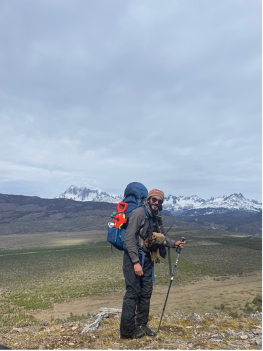
As we got to the bottom of the mountain we delayered, had a quick snack break, and threw on some music for our final kilometer. We took our time walking, talking about the best 24 hr. adventure we had ever experienced and dreamed of when we would be back next. When we reached the road, Camino Lago Brown, we could see the summit of the mountain, a place that we held so much gratitude for. Seeing it from afar, put into perspective how impactful backpacking in this region has been for me. As I turned my back and headed towards base camp, I thought about the history of the land and specifically, it’s strong ties to the native people of Patagonia. Through my time of being in Chile I’ve learned about the misshapen and idealistic concept of Patagonia that most outsiders have, including my past self. I’ve been given the opportunity to experience Chilean Patagonia’s culture and meet many local people. From them, I have learned that people and their culture are what make up an environment and therefore allow it to thrive. Yes, the many landscapes that make up Patagonia are beautiful, but the people and their culture are the true forgotten beauty of the region. As much fun as it was to write this blog and joke around, I hope that you will take the time to think about your concept of Patagonia and what has helped to shape it. Have you fed into the documentaries which only focus on the “pristine” environment that Patagonia is commonly described to have? Do you praise Doug and Kris Tompkins for “saving the wild landscape” that makes up this area? I myself have fallen victim to the common U.S. concept of Patagonia. But, here I am now with a new concept of this region and an even greater love for the area and its people. All I ask is that you take the time to think about what plays into your perspective and furthermore your narrative of the concept of Patagonia.