
By Addison Spitzer, UVM
While we drove to our first field camp (Khwai, or NG18) in the Okavango delta, we came across many African animals such as the giraffe, lions, leopards, and elephants. None of these animals seemed to excite me more than what appeared to be the colossal snout of the African Buffalo (or Nare in Setswana, one of Botswana’s official languages). The buffalo was with its herd in the middle of the road. They pointed their noses up at the cars to identify us before hurrying off into the dense thicket. This reminded me of the Holstein cows that I milked over the summer and I instantly fell in love. While the African buffalo looks really similar to domestic cattle, their tempers are very different. Sixteen told me that these animals are regarded as one of the most dangerous animals as they can charge without warning. Despite the Buffalo’s large size, they can run up to 50 kilometers per hour! The most dangerous buffalo are the bad-tempered solitary males because they are constantly harassed by lions.
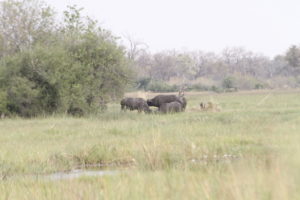
My first sighting of buffalos during a transect. Picture by Addison Spitzer.
The African buffalo or the Cape buffalo, is also known as Syncerus caffer. They tend to live in the Duba plains in Northern Okavango, because these animals are water dependent and go in the direction of water. While doing one of our transect surveys, we traveled to the floodplains of Khwai. While we were there, we saw two lone males 800m away from the main herd of one male and 3 females. Buffalo are very gregarious animals who live in a herd with one dominant male and other males in the periphery. This is so the dominant male can have mating rights to the females. Both sexes have horns and can weigh up to 800 kg. Males have a boss to protect their heads when fighting. A boss is formed when the horns grow close to each other on the top of the head forming a helmet. In the morning of my day off from field monitoring Kaggie and I spotted a lone buffalo behind our cabins about 1000 meters away. We deduced that this was a male because only old males leave the group because they cannot keep up with the herd. A herd of buffalo may be as big as hundreds to two thousand individuals. We have only seen a group of 6 so far. The majority of the herds may be closer to the heart of the delta and as we travel to various parts of the delta, we may see more buffalo.

Buffalo are grazers and like to spend the cooler parts of the day (early morning or late night) eating couch grass (Cynodon dactylon) and ruminating during the hot afternoon. They are considered bulk grazers which means they to eat up to 15% of their body weight every day. Buffalo can live up to 25 years, this may be due to the protective nature of the herd. They tend to protect and take care of their blind and afflicted herd mates allowing them to live long sheltered lives.
One of the more serious problems with the Cape Buffalo is the transmission of foot-and-mouth disease, a contagious viral disease that causes ulceration of the hoof and mouth. We learned from Mr. Bhatusi Bastille during his presentation in Maun about the buffalo barrier and fences that manage the exit points out of the delta to separate the buffalo and cattle in Botswana. Buffalo are natural carriers of this disease so they are not affected but it poses a serious problem to domestic cattle. If cattle are diagnosed with foot-and-mouth disease, all of the cattle in the area are destroyed.