By Max King of University of Vermont
While not everyone in the group might have felt the same, or at least not in the moment, I enjoyed the 4am wake up and the quiet shuffle of students eating breakfast and packing their bags up on the morning of the ñandu census. The sounds of zipping zippers and scraping sporks ended with the thud of van doors and we were off to the drop-off point for our transects.
At the southwest end of the Chacabuco valley, where the landscape opens up to rolling hills of Patagonian steppe, only ~200 ñandu, or Lesser Rhea, make up the larger of two known sub-populations in Chile. Here, a rehabilitation program is working to support this small population of flightless birds by breeding ñandu and providing habitat for juveniles to acclimate to survival in the wild before releasing them into the steppe. Our job was to conduct a census of the entire property of Predio Ñandu to best estimate the number of individuals in the region and provide information on how they are distributed within the property. The data that we collected was compiled with the ongoing research that Round River has been doing here each semester.
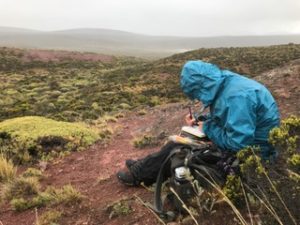
As we approached the Argentinian border, we pulled up to the Chilean carabineros checkpoint, where it seemed that the guards might not even be awake yet. As we were climbing out of the vans and gearing up to walk the rest of the way to our transects the door opened and an officer came down to let us through the gate. We hopped back in and drove few more minutes to the drop-off point before splitting up into our transect pairs and hiking to our assigned starting coordinates. When my partner Izzy and I got to our coordinates, we had a few minutes to rest and watch a small group of guanacos marching across the ridge behind us, before all the groups were to start their transects at once. Then, at 07:30, the fifteen pairs of students started slowly walking the parallel transects east towards the Argentinian border, recording observations of any ñandu they could see.
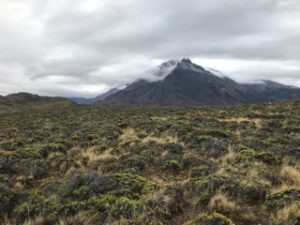
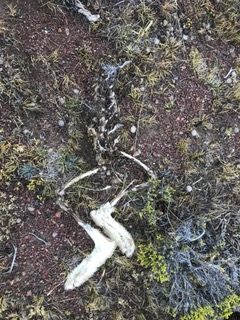
The ñandu were well camouflaged among the shrubs of the steppe, which grow in small, cushion-like clusters. For a while it seemed nearly impossible to spot them, with only a long, skinny neck to distinguish them from the shrubbery, but before too long Izzy spotted one walking across a ridge about 150m away. A closer look through binoculars revealed the heads of several more peeking out from behind the ridge like periscopes. It turned out to be one adult with six juveniles, or cría. We recorded this in our notebooks and continued west with lifted confidence and a new strategy for spotting them. Scanning the horizon for periscopes this way, we were able to report a total of 18 individuals by the end of our 6km transect. We also came across several hare and guanaco carcasses, as well as a ñandu nest with eggshell fragments. We took notes of these locations to report back with our data, which might help inform the breeding program about where the ñandu are choosing to nest and what level of predation they may be exposed to. After we reached our end coordinates, we started hiking back toward the road to find the pickup point.
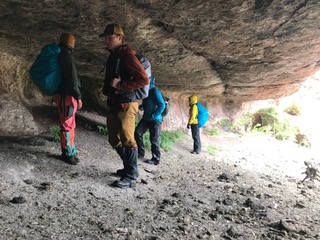
On the way, we happened across a few other students and our instructor, Sara, who were walking along a cliff in search of caves, hoping to find petroglyphs (and hoping not to find pumas). We followed along and eventually spotted a promising hole in the base of the cliff. Inside, there no pumas or petroglyphs… only a few piles of cow pies. We decided that it would be a nice place to stop anyway and eat lunch, sheltered from the wind and brief rain showers that had been coming and going throughout the day. After we ate, we hiked back to the vans, sharing stories of our day with the other teams along the way.