
by Katherine Rigney, of Carleton College
How do you begin to describe two weeks like the two weeks we’ve just had? I suppose as Julie Andrews once said, the beginning is the very best place to start. So we’ll try that.
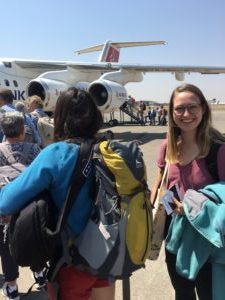
Just over two weeks ago, nine travel-weary girls met up at the Johannesburg airport—first tentatively, because it’s awkward to introduce yourself to strangers who just look like they MIGHT be the right age to be on this program, then more easily, because once there were a few of us sitting together it was blindly obvious (from the backpacking packs and the several reusable water bottles per person and the Chacos) that it was the correct group. We landed in Maun in the peak of the day’s heat, which hit us like an anvil as we stepped onto the asphalt of the runway; we met up with three of our instructors (Gen, Ben, and Cosmos), and they drove us to a beautifully set up campsite at a safari lodge that would be our home for the first few days of the program. We started classes there, took an uneventful trip to immigration, had a lovely dinner with the director of Round River, swam in the pool to cool off (cushy, I know!) and adjusted to the heat (in theory), and before we knew it, we were headed out into the bush for two weeks.
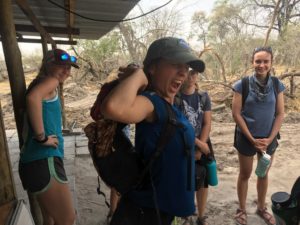
The day we spent traveling to our first camp, Tau Camp (Lion Camp), in NG18 was a long and dusty one. The roads north of Maun are unpaved, and haven’t been leveled since the last rains, so are more like teeth-rattling roller coasters of dust than easily driven roads. The drive that might have taken five hours with perfect conditions instead took eight, because of slow road conditions and the bouncing causing our bags, secured to the top of one of the cars, to bounce down into the road a few times. (Shout out to the safari vehicle that stopped to take our picture as we struggled, dustily, to reattach the bags to the top of the car!) When we arrived we looked like we had aged fifty years, with hair dyed white from the pale dust, and dirt creased in the lines of our faces and necks, but we were home for the next twelve days, and during the drive we had already seen and freaked out over elephants and giraffes and zebras for the first time. So that made up for how hungry and grubby we were.
I can’t give a full account of every day we were at Tau Camp, because if I did, this blog post would be the length of a novel, so I will restrict myself to the highlights. The nine of us absolutely threw ourselves into learning as much about Botswana’s history and culture as we can (to the extent that recently our instructors have been laughingly telling us to calm down so they have something left to teach us after ten more weeks). We have been studying our Setswana, and memorizing Latin names of species we’ve seen, and quizzing each other on tree identification as we drive around, and even without consciously trying very hard on our natural history, we have absorbed so much about the natural world around us just by going on transect every morning. How to tell the difference between male and female giraffes (males have lost the hair on top of their ossicles—the horns on their heads—from years of sparring by knocking their heads against each other’s bodies, while females have fuzzy tufts on top throughout their life), how old elephants are (we’ve seen some true BABIES: one that was likely this year’s calf, and several yearlings), how to identify a species of bird of prey, Bateleurs, from a distance (they have a peculiar rocking motion when they fly), and so, SO much more. During our time at Tau Camp, between us we saw nearly 150 species, none of which any of us had ever seen before in the wild. Over 75 of those species were seen by everyone on the program, while the others were seen only by some. For me, all those new species are absolutely mind-blowing. I expected to be floored by the sight of elephants and giraffes in the wild, and believe me, I constantly am. But I’m just as in awe of the staggering diversity of birds in the delta, and all of the ungulates that I had never heard of before coming here (kudu, sable, roan antelope, steenbok, waterbuck, red lechwe), and the trees and bushes that eke out a precarious living in the climactically extreme delta, amongst all of those large herbivores.
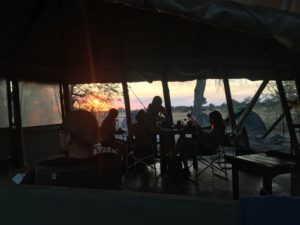
Other highlights from our time so far at Tau Camp include:
-One day, we came home from a game drive a fully grown female elephant was browsing in the trees about twenty feet from our parking spots, along with her young calf. We sat silently in the cars and watched them eat for about fifteen minutes until it became clear they weren’t planning on going anywhere, when we pulled around to the back of camp and they eventually wandered off.
-Another night, Hailey exclaimed that there was a cat in the dark kitchen (!), and when we investigated, we found a genet, a small lithe cat-like mammal with a very long tail and a tiny face, who was significantly more alarmed by us than we were by it.
-One night we all had to go to our tents and prepare for bed a little early because we heard lions on all sides of our camp. A little nervous, sitting awake in our tents, we heard elephants trumpeting and growling defensively in the distance—definitely, a scary night to be a small elephant, but we never saw any carcasses, so the hunt may have failed.
We are all so in awe of how much we’ve learned so far, and can’t wait for all the new sights, sounds, smells, and information that this place will gift to us in the coming weeks. Ke a leboga, NG18!
Katherine Rigney