By Dominic Noce of University of Montana
As I’m writing this, we unfortunately are hearing the news that we must return to the U.S. early due to Coronavirus concerns. Since most of this week has been us preparing for our departure back to the States, I thought it would be better for me to reminisce on some of our best predator sightings while in Mababe.
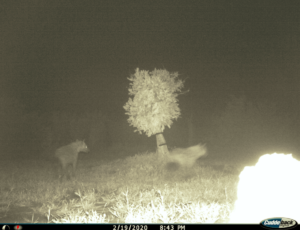
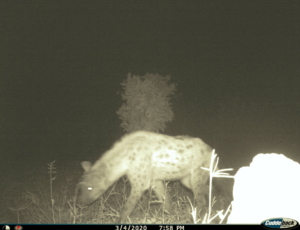
On just our second night in the bush, we were around the fire after dinner when we heard a loud whoop from a hyena not far away. Most of the students entered their tents for bed not long after the first whoop, but those of us who stayed by the fire, along with our instructor Gen, witnessed a large clan that numbered at least 15 individuals circling around the campsite. It was a very exciting first hyena encounter and it allowed me to understand just how large some female hyenas could get. While the clan was probably scouting for food, they did not view us as prey. Only a few individuals got close enough to really see and it felt more like they were just curious about all the new activity in the area. After that night we’d usually have only one hyena in camp trying to steal our food scraps. He was a small male that Gen had affectionately named Ed after a character from Cowboy Bebop, an animated TV series with Ed as a particularly fun and lovable character. Our “Ed” was not aggressive at all and was quite easy to shoo away from camp. In fact, Gen related a story to us about coming face-to-face with a tired, and yawning Ed, in the camp bathroom.
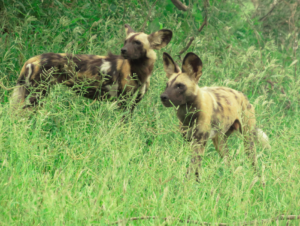
Another great predator encounter occurred only a few days later. After herbivore transects one morning, we heard from the escort guides, Colleen and Rasta, that there were dogs around camp. Not even 5 seconds later, there were impala stampeding through the mopane woodland near our tents, closely trailed by 2 African wild dogs! We scrambled into the vehicles and caught a glimpse of the dogs splitting up and corralling the herd into the mopane to better single out a target. It’s always exciting watching predator-prey interactions, as you can see the different techniques and strategies that both predator and prey utilize. In this case, the impala had a unique rocking horse-like stride when they ran, which makes it harder for the dogs to grab their stomachs. We never saw the outcome of this hunt, but we did catch up with the pack resting by the river the next day.