by Grace Budd of the University of Vermont
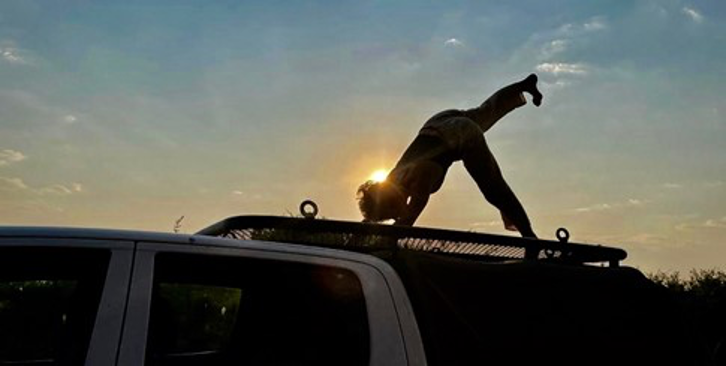
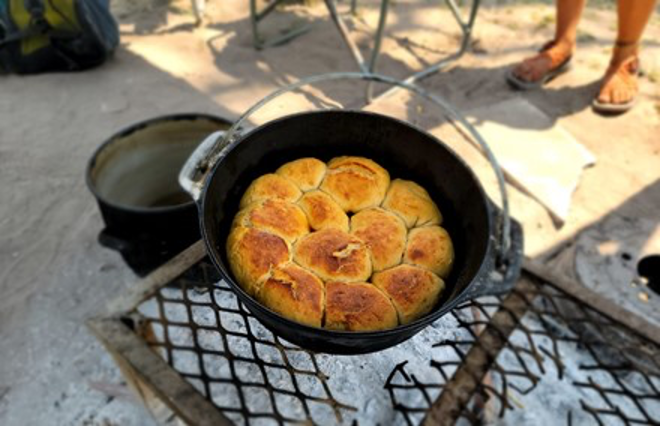
My arms stretch up to the sky, the blue blanket reaching the horizon in every direction. Breathing in the dry air and releasing it back out, I bring my arms to my chest and flutter open my eyes. In front of me is an Audi (African Fish-eagle), perched across the river on the highest branch of the knobthorn tree. I’ve taken a liking to this species since arriving here, and her presence during my yoga practice makes me feel even more connected to where my feet stand. I’ve been practicing yoga and meditation on the top of Lucy (my personal favorite of the Land Cruisers we have), as a safe way to move my body and settle into my surroundings without being snuck up on by an elephant (it sounds impossible, but in reality, they do appear out of nowhere sometimes). On this morning, the sun is still low enough that it doesn’t hurt to be under it, and I’ve taken a day off from running transects, so I’ve decided to try and make bread after my practice. A few days ago, Mmapula took time out of her evening to show some of us how to make borotho, or bread, over the fire. I’m not the best baker in the group but having some free time and dreaming about the sweet, soft, bush buns is enough to make me take that chance. Mmapula is a Khwai Community Trust member who we are staying with at Khwai Community campground. I can confidently say that throughout this entire trip, even the parts we haven’t experienced yet, would not have been the same without her. Channeling Mmapula, even though she’s 10 meters away in her camp hut, I take out the ingredients and try and put them together in the order which she showed us. 4 and a half heaping cups of flour, 5 and a half-ish heaping tablespoons of sugar, about a quarter size in your palm, or about a teaspoon of salt, one mug of water from the kettle, a temperature that is warm but doesn’t burn your hand, and my favorite instruction: 3 heaping dough-filled hands of oil. That last one I think needs to be shown in order to do it correctly, but Mmapula moved quickly, and we just wrote down our observations of the amounts she was using. I almost forget the yeast, but it all ends up in a sticky ball ready to rise in the hot sun.
As the dough rises, Nick, Lexi, Hal and I start noticing vultures flying in across the water where the Audi sat earlier. Assuming they are white-backed vultures, we take out our birds of concern data sheet and start counting. 1, 2, 4, 6, 8, 14, holy crap they just keep coming! Taking a closer look, we realize they aren’t just the White-backed vultures, there’s 5 or 6 Lappet-faced vultures, a few Hooded vultures, and one suspicious looking gray vulture that we can’t quite place as anything other than a Cape vulture, which would be highly unlikely. Dix is called in for expert opinion because Nick and I can’t seem to find another option besides the Cape.
This investigation of one vulture takes longer than the rising bread has time for, so I step away to continue my attempt at bread making. Contemplating what could be dead across the river causing that many vultures to appear all at once, I oil the bottom of the cast iron and start pulling balls the way cheese makers would pull mozzarella, but much less swiftly. The dough is better than the last time I tried, which ended in sticky hands and burnt buns, but the balls still don’t look as good as when Mapula did it. They will have to do. I’ve just put them over the hot coals and placed more coals on top of the lid, when Dix re-appears from the water’s edge where he and Nick had gone off to identify this vulture.
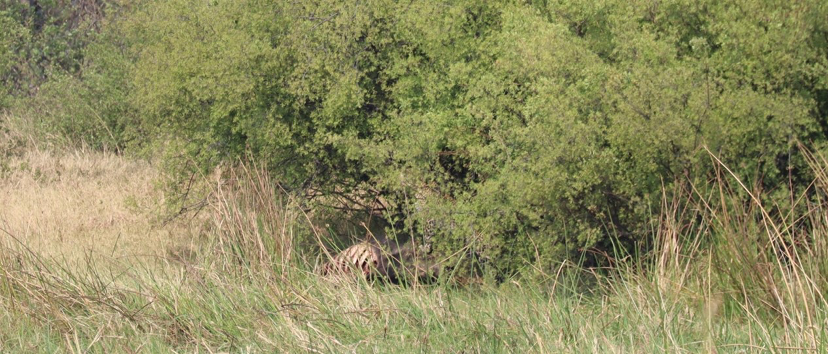
Dix tells me and Lexi that there is a leopard on the other side, eating the carcass that the vultures had come to pick on. This is a pretty awesome way to describe our time in Khwai and I take note in my head of how I’ll explain it to friends and family: “I was making bread and a leopard came to have a bite to eat right by our campsite!”
Following Dix, we walk less than 50 meters from where I’ve been baking, and sure enough, across the water we can see the ribs of a buffalo carcass sticking up by a bush and right next to it lays the distinct pattern of a leopard coat.
Later in the day, Dix, Mmapula, Kebife, and Dux sit making fishing line on Mmapula’s front step. We are about to drive down the road to a spot on the river where we can see our surroundings enough to go fishing.
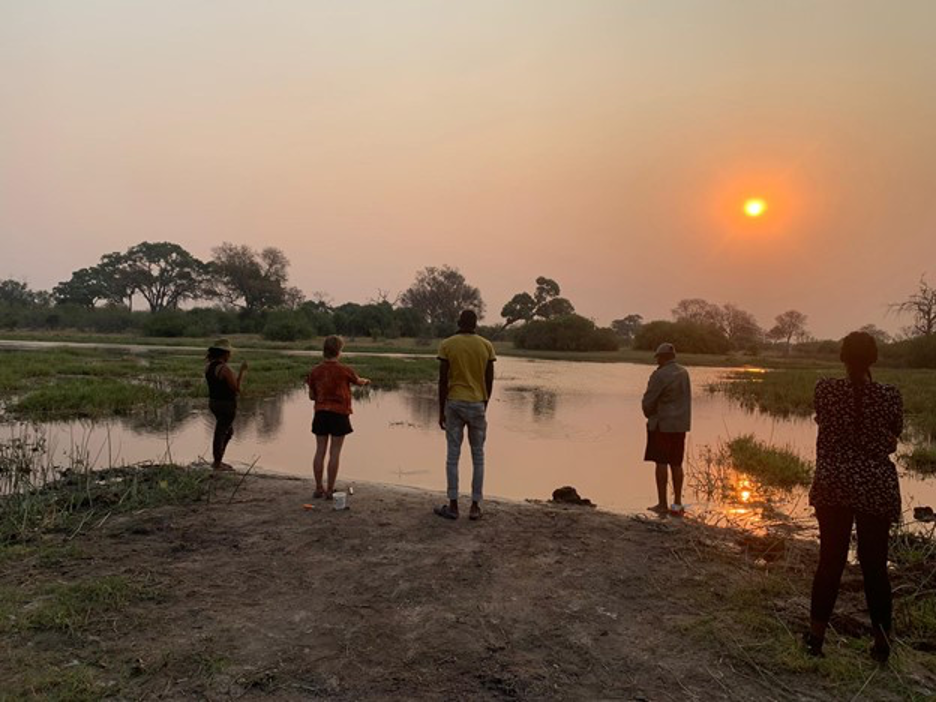
The sun sits low by the horizon, and our toes are just inches from the water I’ve been wishing we could swim in all week. Ten days of temperatures around 100 degrees Fahrenheit will make you question if swimming with the hippos is really such a bad idea (it definitely is and we will not be exploring that). I’ve never caught a fish before, so I jumped at the proposition to try and catch some protein for dinner. I watch Dix cast, swinging the line in a circular motion with the tiny piece of chicken on the hook, until he is satisfied with the momentum and lets the line fly off into the water. The hook slips into the sherbet pink path leading to the sun that hovers in a haze above the line of trees. Even on our last day in this place I still can’t believe it is real.
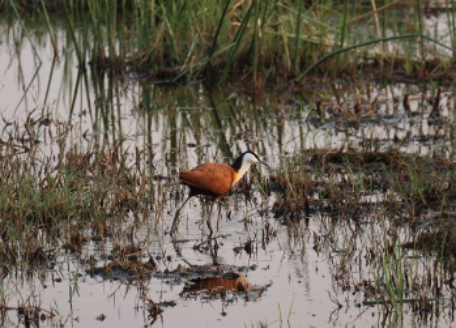
I get distracted watching an African Jacana strut around in the reeds, but Dix calls me to try my hand at casting a line. I get a good toss and wait. Next to me, Dux is hitting the line from underneath, snapping his wrist up, pulling the line in, casting it back out. I figure he is just trying to get a better distance from shore, but a few moments later I realize he is reacting to small nibbles on the bait. I get a big tug and try to mimic Dux’s technique, but the fish gets away. I was too slow. With Dix’s patience I try once more, but again I am too slow.
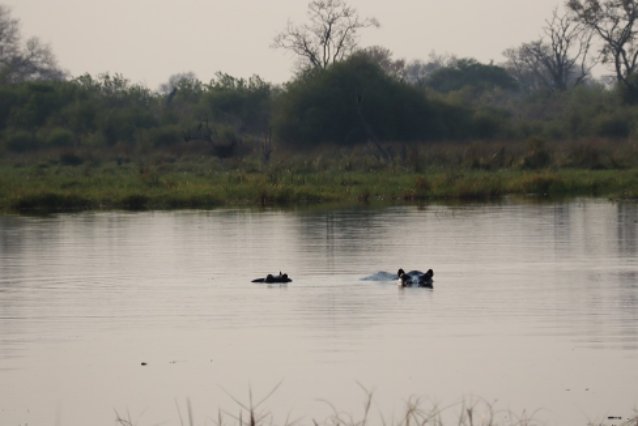
Others try out the fishing technique, and we’ve suddenly got two fish reeled in and waiting on the shore to be cooked! Dix’s line just keeps making them bite, Chris reels one in, Lauren reels one in, and then Dix and I both reel in catfish. As Mmapula is laughing, saying she’ll burn her line because it is so unlucky, we hear a loud snort and look over to see that the group of Kubu (hippo) we saw on our drive over is now about 40 meters from us. Lauren and I count them and come up with at least 12 or 13. My eyes are locked on a huge one that has brought their body far out of the water. They open their mouth wide, but not in our direction, more of a sleepy looking yawn. We are all intently watching the group, but they are not yet curious of us. They roll around in the water, continue grazing, and a baby splashes up from behind one of the adults. I thought I would feel much more fear being close enough to a hippo that I could watch them without binoculars, but instead I feel comfort in this moment that we share the patch of water without conflict. We keep fishing, but I can see Dix and Mmapula watching the group from where we stand. They continue to get closer in the next 20 or so minutes, until four little ears pop up out of the water about 20-25 meters in front of us, big shiny heads emerging beneath them.
A loud ‘Pffffffffffftttttttt’ hits the water, one of the Kubu letting us know they’re there, and we have a sort of stare off. They watch us, we watch them, but there is no urgency about either of us. They stay looking at us without making much more noise, and we finish pulling lines in, waiting as Lauren reels in our last catch of the night. Before heading back to camp to fry up our bream, we thank the three fish, and Dix chuckles, petting the fish he says “we have to make them happy.”
This small snippet of our last day in Khwai feels important for me to share because while I am learning so much from the unique wildlife interactions and sightings we are having, the lessons I’ve gained from the community members and our instructors about simple day to day activities have made me feel most connected to this place.
My bread was a bit underdone, but I still made something edible over coals, a technique that Kebife and Mmapula showed us how to do. Even with the fear of wasting materials, I felt confident enough to try their baking technique so that I could do it once we left their camp.
We got to see a leopard, and then Dix taught us that if we watch the Vultures on the tree, we will know when the leopard is no longer there because the vultures will leave the tree and begin eating the carcass again. I spent the rest of my day watching those vultures over the top of my kindle readings or watercolor set, just so that I would know the moment the leopard decided it was ready to move on.
I caught my first fish ever, thanks to the patience given to me when I couldn’t figure out how to snap the line up fast enough. Even though I had to release it because it was too small to eat, the success of actually reeling something in will help my muscle memory to be able to try fishing like this again.
We stood closer to a group of Kubu than I ever thought possible, and I learned the feeling of mutual respect between myself and that wild animal. Through multiple close interactions with potentially aggressive, large herbivores this week, (Elephants through camp, 100 buffalo across the river from camp, and now this large group of hippos), I have learned that they can approach your space in a non-threatening way and simply keep going about their business. The problem will only begin when you come into their space or fail to maintain awareness as they approach you. I am so grateful to be surrounded by such good people who are teaching us how respect the wildlife around us. As a group of students who are coming from conservation and wildlife educational backgrounds, it initially seemed like a given that we would understand how to respect a wild animal, but the reality is we have never been around life like this. Since being here I have already learned much more about what that respect looks like, and how unique the interactions between wildlife and humans are in this area of the Delta. Without the guidance of people who have lived and learned in this environment their whole lives, finding where I fit into this place would be much more difficult.