
Leopard in tree guarding its impala kill. Photo by Kristie Weeks.
By Sam Gerdts, Saint John’s University
Our camping at NG18 turned out to be an amazing experience. Our team was joined by an escort guide within the area named Amos who gave us a lot of insight on the area we were in and even more about the communities of Botswana. Our Conservation Biology Natural Resource Management (CBNRM) class was greatly influence by what Amos, a local NG18 professional guide, and our instructor Sixteen had to say since it related so much to their lives. CBNRM is a program set up by the government in order to help with the conservation of the beautiful environment we are here to study. It was a great pleasure to be able to learn from local community members about the problems and struggles that still go on within the local communities. It is a constant struggle that can only be solved through mutual cooperation.
Other than classes, our research has given us amazing sighting opportunities of animals we all grew up watching in movies and reading about in books. One day a group came back saying that there was a dead impala (Aepyceros melampus) dragged up into a tree, which Sixteen and Amos confirmed was a leopard’s (Panthera pardus) doing. The next day I was on a transect drive with Sixteen we returned to the leopard sighting. When we got there we saw the magnificent cat in the tree munching on its kill, an experience that will stick with me forever. On top of seeing leopards, herds of elephants (Loxodonta africana) ranging from numbers of 5-150 were commonly seen on drives. Impala are something that Amos classified as the “reliable animal”, because if we didn’t see any animals we can always count on seeing an impala. I thought that was funny, until I realized that it was very true. There are impala everywhere.
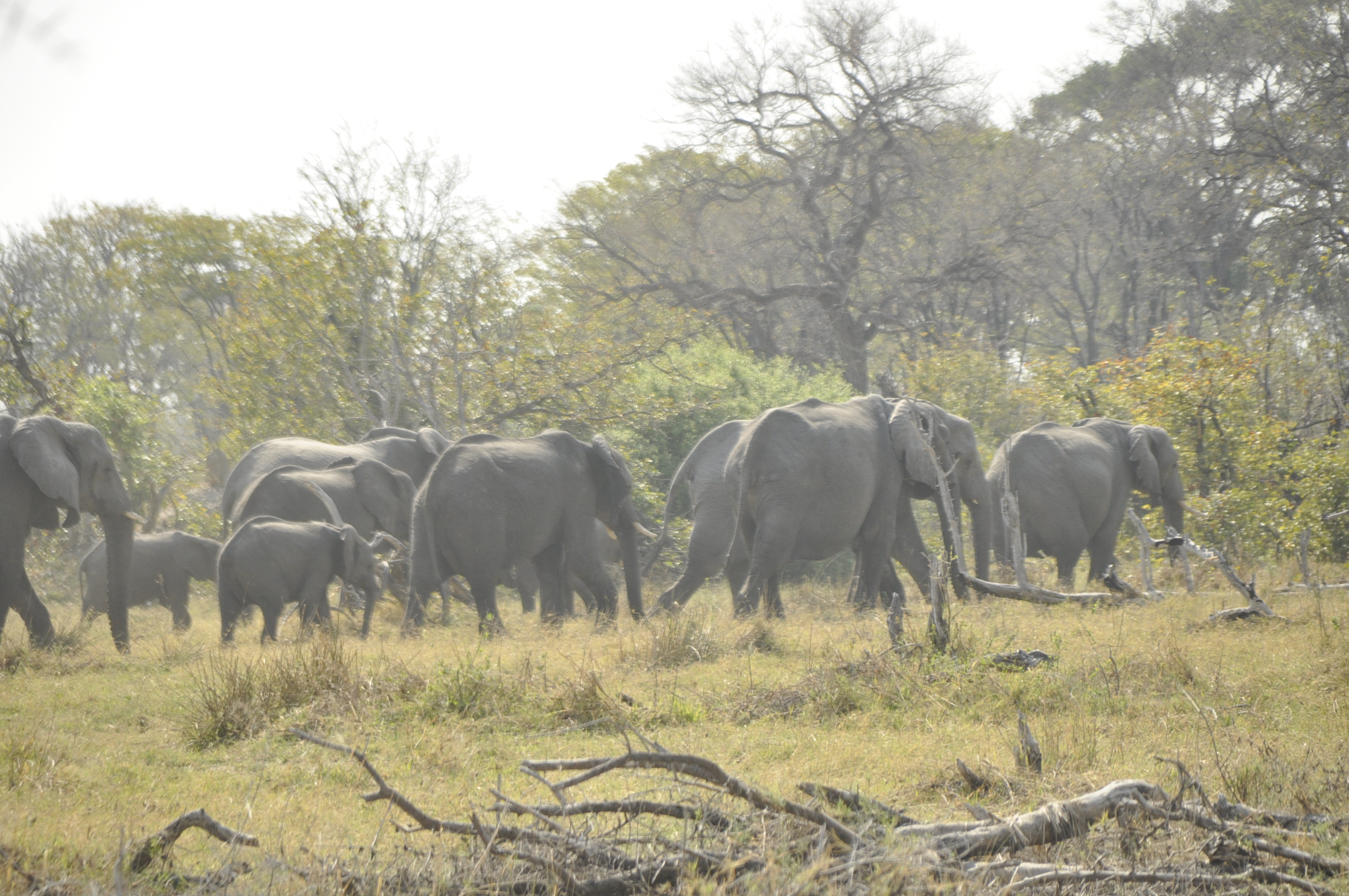
Herd of elephants seen while on transect. Photo by Kristie Weeks.
Transects are by far my favorite part of the program. Not only are the sunrises exquisitely beautiful, it is truly amazing how many animals you can see in one day, and quite another feeling when you spend 2-3 hours driving seeing one animal, which does happen. One particular transect with Samara, Amos, Lori and I we ran into a herd of elephants. At first we only saw 30, which is still a big heard, but as we drove around the corner we saw the rest of the herd that consisted of roughly 150 elephants. Our transects usually are 20-22 kilometers in length, but this one was shortened to 14 because of all the elephants crowding the roads. We honestly could not go any farther without running into elephants. The danger was that if we got to close they would potentially charge, so Amos, our guide, made the executive decision to turn around and end the transect. On the bright side, there was talk on the radio of a female leopard with a cub near our area so, with Amos at our side, we went to investigate. What we found was truly amazing and a once in a life time opportunity.
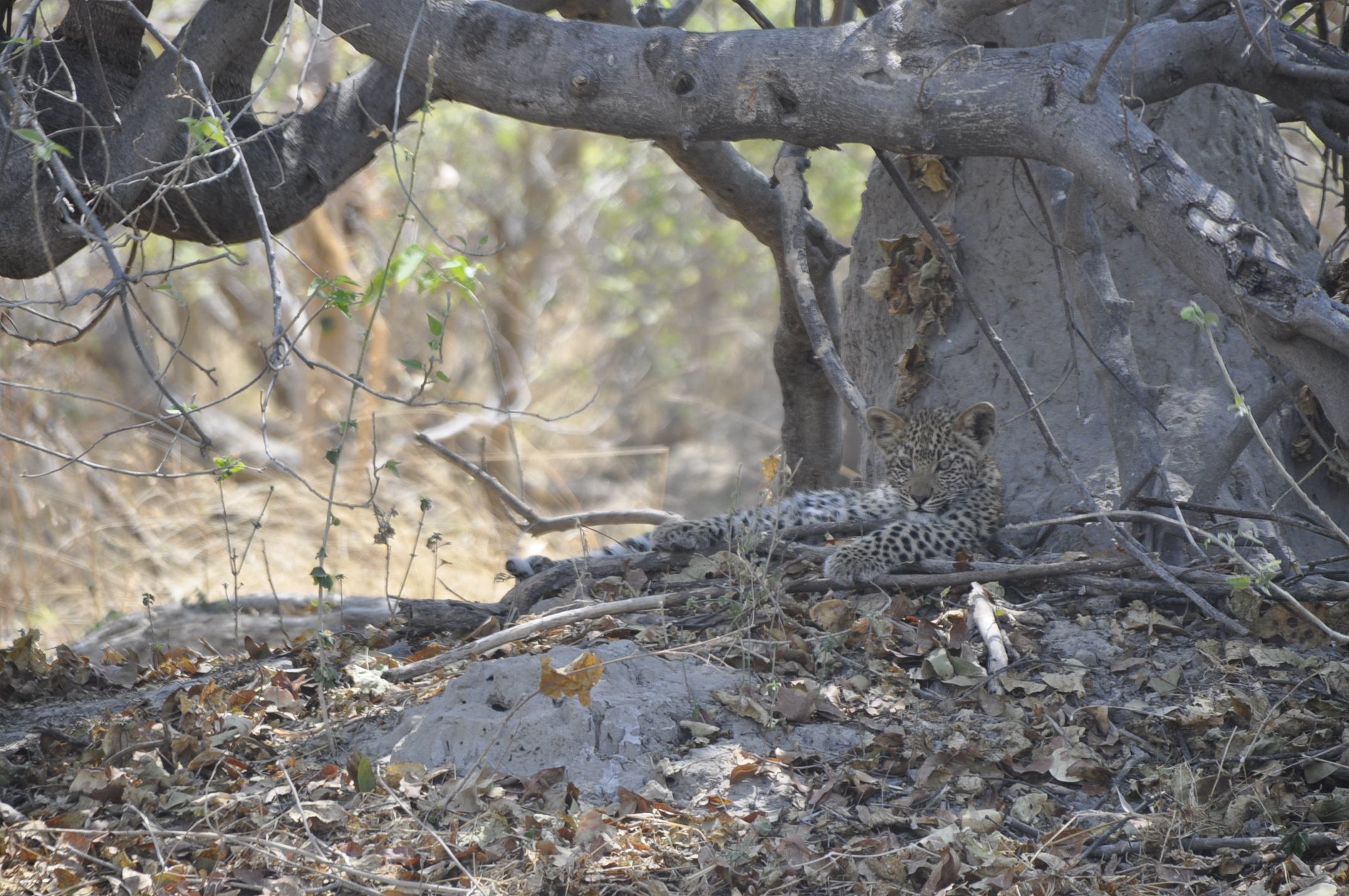
Leopard cub sitting under a tree in the shade while the mother is tearing up an impala for the mid-day meal. Photo by Samara Moreira Muller.
Even though this is just the beginning I am learning so much about the wildlife and conservation in Botswana. I can already tell that the rest of my time here is going to fly by with the blink of an eye.