By Maxwell King of University of Vermont
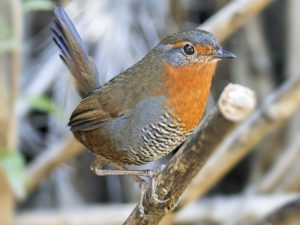
Chucao Tapaculo (Scelorchilus rubecula)
Like many species of birds in Chile, the common name of the chucao tapaculo is an onomatopoeic derivation from its song. The surprisingly loud “chu-chu-chu-caao” ringing out through the forest was one of my favorite sounds in the woods during my time in Patagonia.
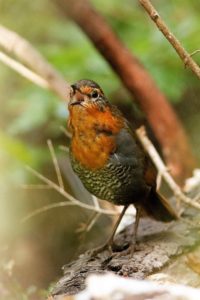
The temperate rainforests of southern Chile are home to three species of the rhynocryptidae family, including the chucao tapaculo (Scelorchilus rubecula), the black-throated huet-huet (Pteroptochos tarnii), and the Magellanic tapaculo (Scytalopus magellanicus). While these three species may resemble one another in overall form, they are all of distinctly different size and color. The chucao tapaculo is the intermediate of the three, measuring 18-19cm from beak to tail, and can be identified by their black and white striped breast, rusty-red throat and eyebrow, and their short tail, which stands upright when they are alert.
The chucao usually remain in the dense understory near the forest floor where they build their nests in cavities and forage for insects and fruits. They are not built for flight, having relatively short wings, so they depend on this dense vegetation to move across the landscape, find a mate, and protect their nests and young from predators, such as güiña (Leopardus guigna), austral pygmy owl (Glaucidium nana), and the Chilean hawk (Accipiter chilensis). The chucao tapaculo are of conservation concern because they are endemic to the south-temperate rainforests, a habitat which is becoming increasingly fragmented by logging and the clearing for livestock pasture. Given their limited flight, this compromises the species’ ability to survive and reproduce as they struggle to find suitable territory and/or a potential mate. Chucaos rarely venture out from the safety of the understory cover.
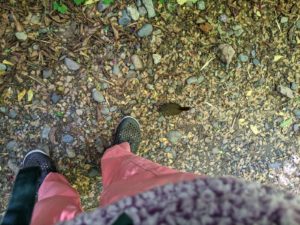
Though common, the chucao is somewhat elusive and you may only hear the song and calls of these birds without seeing the singer. If one happens to vocalize nearby, they can best be spotted by standing still and gently brushing the forest floor or nearby branches, which will usually coax the curious birds out of hiding. After convincing the chucao that I was not a threat, it was not uncommon for them to warily hop right up within a meter or two, but never far from the safety of the brush.