
by Ian Nelson, of Westminster College
It’s been a busy and eventful week in the Round River Bostwana student program! To start it all off we finished our work in the Mababe village area and moved back to Maun. We had a great time in Mababe and were sad to leave. On the other side of the token however, we were eager to return to the creature comforts we enjoy at Island Safari Lodge, including bathrooms, showers, a pool, internet, and a bar.
On our first day in Maun (Nov 5th) we enjoyed dinner at a local restaurant, Tandoorei, which serves up some of the best Indian food in Botswana. It was a welcome change from the routine meals that we have in the field. After dinner we returned to our camp at the safari lodge and prepared for the upcoming week with a good rest!
Over the course of the week we had our midterm exams which consisted of several assignments such as Grinnell journals, species accounts, and our humans and the environment midterm essay.
Species accounts are one of the major assignments that we have worked on cumulatively over the course of the semester. Species accounts give students a chance to select 3 species which they have a particular interest in and observe them in several instances to understand them on a deeper level. Each student selected a mammal, a plant species, and a bird species. I chose to write my accounts on Kudu, the African Fish Eagle, and the Camelthorn Acacia. Each observation is then written into a cohesive species account which includes behavior, interactions with other species, habitat, weather, and other information that is pertinent or interesting. The species accounts are extremely involved and require careful observation skills, writing skills, and attention to detail. This assignment was very helpful in honing field observation skills and scientific writing skills for us all.
Another similar assignment we worked on was the Grinnell Journal. For the journal we take detailed field notes over the course of one of our transects and write up the day in detail. Similar to the species accounts, this assignment helps immensely in our development of field observation and writing skills. We describe, in detail, the route of the transect using spatial cues including GPS points, distances, elevations, and cardinal directions. In addition, we describe the main habitats the we encountered along the transect and some of the species interactions that we observed. We also relate what we observed on that day to the larger picture of what we have learned about the natural history of Botswana. The product is a comprehensive journal entry which we submit for a grade. The length of the journal averaged for our group at around 15 handwritten notebook pages.
We finished the bustle of midterm week with a celebration. The last day conveniently coincided with Caroline’s birthday, so on Friday we had a fantastic dinner cooked by Lauren and Jack, with muffins for dessert (we would have had cake but it is hard to find in Maun).
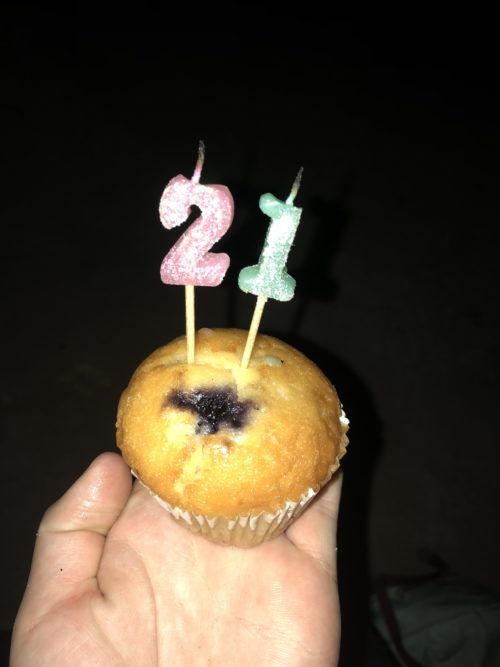
Celebratory muffin for Carolines birthday
After dinner we went to a local watering hole called the old bridge where we had drinks, played pool, and celebrated the birthday into the night! Without skipping a beat, we woke up early on Saturday, packed up camp and moved south west to Phuduhudu, eager to start work for the upcoming week!
Phuduhudu is around a three-hour drive from Maun. It is different from other concessions where we have worked, in that it is not in the vicinity of water. The ecosystem is a desert and in the dry season it is hot and sandy. In our camp we have very little shade provided above the cooking area by a large camelthorn acacia. Several students set up their tents on a sand dune overlooking the cooking area, which is the largest topographic relief I have seen since we arrived in the country. Their tents are known as the “Castle” in our camp.
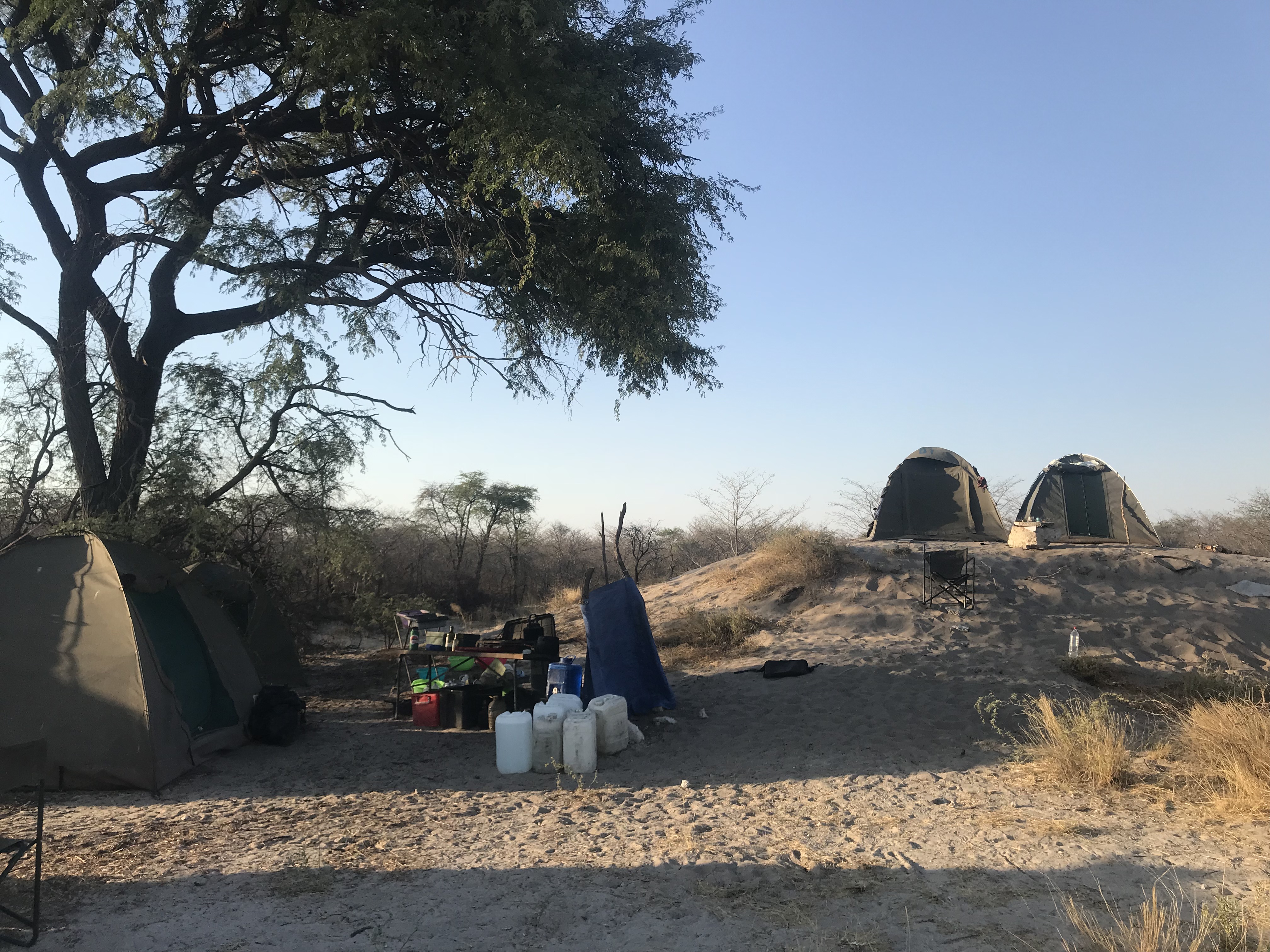
“The Castle” overlooking camp