By: Camden Douglas, University of Vermont
Mopane branches come at you quickly on the narrow dirt roads, and we were ducking and weaving throughout the drive to Sankuyo. We were piled onto the back of one of our trucks, occasionally getting splattered with mud, keeping an eye out for elephants and low branches.
Our community day in the village of Sankuyo, which is populated by the Bayei tribe, was a lot of fun. After filling up our water jugs, we headed to the soccer field and invited the kids to come play with us. By my estimate, it was eight of us versus about twenty-five children. Somehow we had the advantage, and we ended up winning, but not by much.
Next, we drove further into town to a small cleared area where some traditional ceremonies are held. One of my favorite things about my time in Botswana so far has been learning about and experiencing the local cultures, especially the music and dance. Sound and rhythm have a uniting quality – they seem to cross the language barrier.
In this sandy clearing, the dance group composed of older women – or as our escort guide, Willie, called them, “The Grannies” (in fact, one of them is his grandmother) – showed us two traditional games. The first was between two players. There is a small hole in the sand between them filled with ten stones, plus one stone that you toss up and down. The goal is to use one hand to continuously toss the stone up and catch it, while using the same hand to take all the stones out in one motion. Then, while tossing the stone, put all the stones back except for one. Then you try to leave two stones out, then three, all the way up to ten. If you mess up or drop the stone, it’s the other player’s turn. The first to get up to ten stones wins. I was terrible at it.
The second game was similar to mancala, but can be played in teams. There are four rows of ten small holes (the two rows on your side are yours), and you move your stones like you would in mancala, but when you stop in your second row, you take your opponent’s stones in that column. The goal is to take all of the stones. It seemed complicated, and I didn’t get a chance to play – soon it was time for the dance.
We gathered in a semicircle around the main area, where the women stood in a line facing us. As they started clapping and singing, we were told that this song was performed when a girl in the village reaches puberty and begins to enter womanhood. They had one lead vocalist at a time, and it was a kind of call and response. The lead would sing a short melody, and the rest of the group would respond in unison with a complementary melody. Two members of the village played accompanying drums. One younger woman took the role of the girl, and she was covered in the hide of a black-backed jackal. She sat in front of the women and stayed still throughout the song.
As they performed, Willie asked me: “What happens in your head when they sing?” – I didn’t really have an answer. I watched as the women took turns entering the circle to dance, which was a nimble shuffle through the sand. They continued chanting melodies (in a language I could not understand), but the feeling translated. The call and responses were celebratory, hopeful, and emotional – their voices together were powerful and singular.
The performers invited us to join the dance, and we filed in line. Two by two the women took us in arm and shuffled us through the middle of the circle until we each had a turn to dance. I was beaming, and I know my classmates had a wonderful time too, even though we couldn’t move as smoothly as the Grannies.
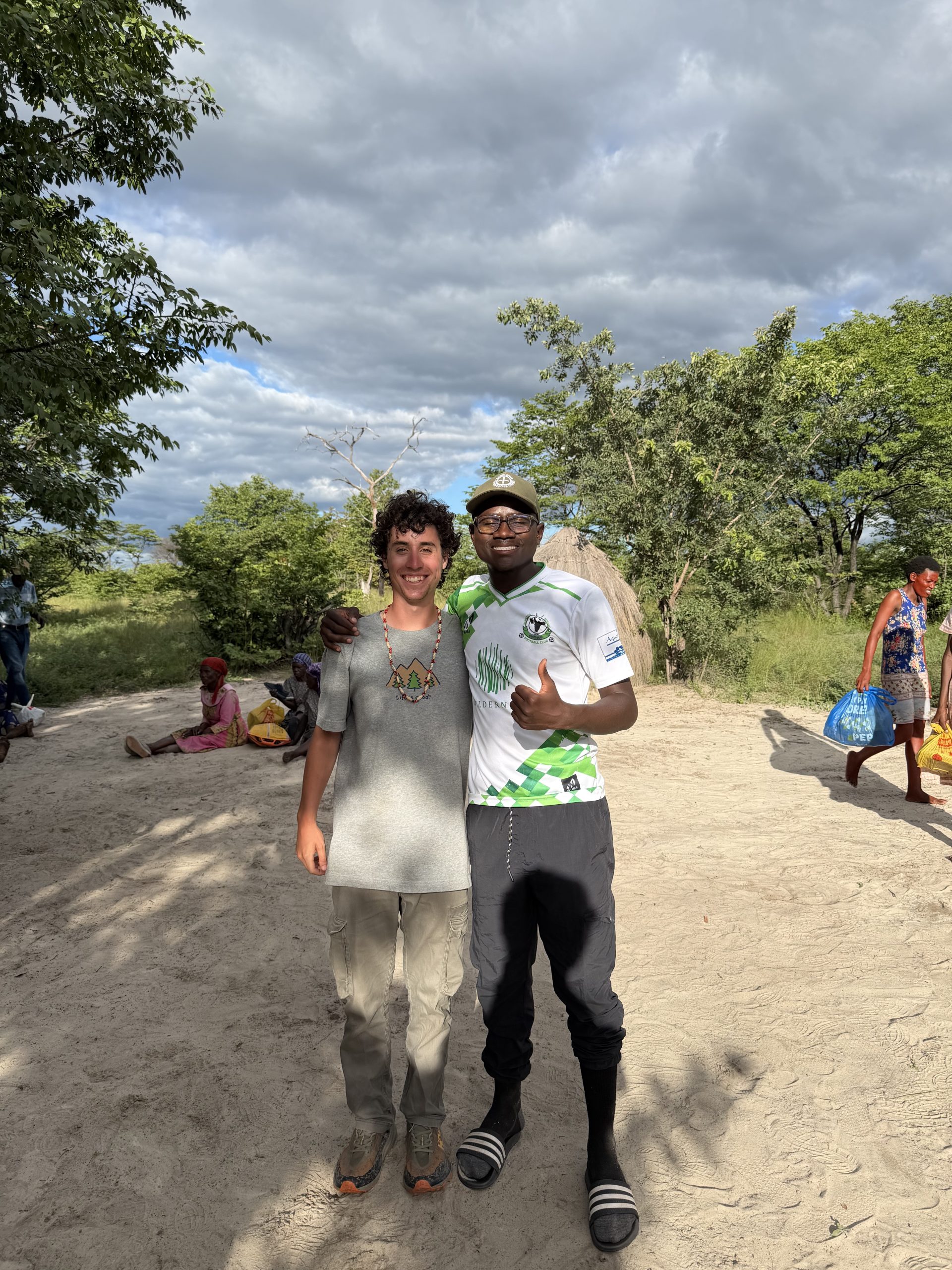
After the dance, the performers laid out a selection of things they had crafted, including baskets, bowls, and containers woven from palm leaves, and palm and bead bracelets and necklaces. I bought a palm bracelet with an intricate dyed design and a necklace with lucky beads.
One of our instructors, SB, who is from Sankuyo, mentioned that this part of their culture is not really practiced by young people. Eventually, he said, maybe in the near future, these traditions will be forgotten. To me, that’s a difficult thing to comprehend, or even face. We got to experience something that may be fleeting.
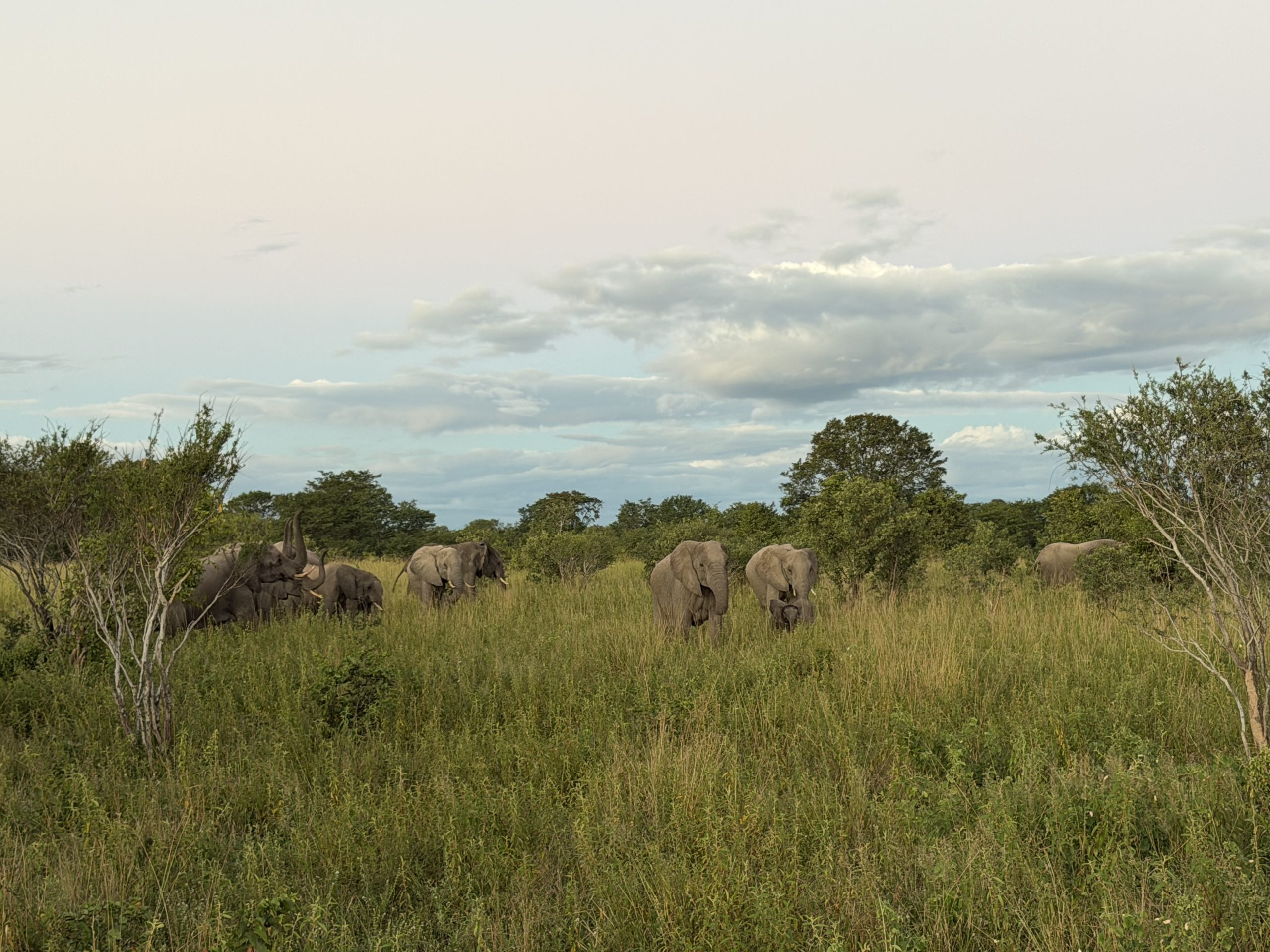
Our aim was to get back to camp before dark, so again we piled into the back of the truck. We drove for a while and dodged branches as the sky started to turn orange and pink. Suddenly, there was a herd of elephants on our right – some so young they could hardly see above the grass. I would guess there were close to thirty elephants, all of them grazing and paying no attention to us. For a few minutes we watched them meander, reaching with their trunks for their favorite grasses. But it had been a long day on the road and in Sankuyo, and the sun was setting quickly, so we returned to camp to make dinner and to get some sleep.