
By Gracie Little of Carleton College
Patagonia Student Program – Fall 2019 Semester
As with many encounters with Mother Nature, our time in Entrada Mayer was a lesson in humility. Those five days of slightly haphazard research, rain, and farm animals chewing on our tents demonstrated the many, and sometimes unexpected, ways in which humans and the ecosystems that we live within can coexist. I’m grateful for the chance to continue reflecting upon and learning from our experiences there.
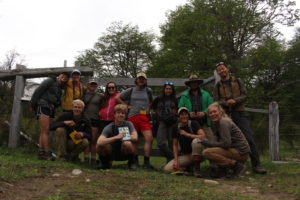
About an hour’s drive northeast of the small Chilean town of Villa O’Higgins, just past the private estate of Chilean mining mogul, Andrónico Luksic, you can find Entrada Mayer: the 4,167 hectare property of Henrique Alcalde. Alcalde, a businessman from Santiago, had contacted Round River about the potential of transitioning his property from a functioning campo, or ranch, into a private conservation area. Round River’s task this past November was to establish a general understanding of what the land’s conservation value might be. Under the guidance of Marco, the property’s caretaker, we would complete biodiversity assessment surveys across rambling property. It includes part of the watershed of the Glacier Mayer, a section of the Río Mayer, a swath of mountainous pasture land and a border shared with Argentina. In some ways, our visit to Entrada Mayer rounded out our experience of land use history in the Aysén region, which now ranged from the well-preserved Pascua watershed, to the recently conserved Chacabuco Valley, and on through Entrada, a still-functioning campo. But American readers be warned, the snow covered peaks and rocky outcrops on the banks of the winding Río Mayer were a breathtaking and unique mixture of farmland and wilderness, a far cry from the rolling corn fields of agricultural land in the states.
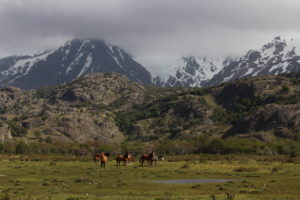
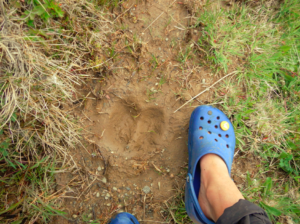
However, coming immediately from an expedition in the Pascua watershed, hopes and expectations of biodiversity were high. Specifically with respect to the idea that huemules, an endangered species of deer, might be found on Alcalde’s property. As a member of the team specifically in charge of looking for signs of huemul, my fingers were crossed that we would find dozens of tracks and piles of scat waiting to be measured, squished and recorded. However, as we continued through our first set of surveys, the acres of heavily burned and grazed land seemed to solidify as a thoroughly uninviting habitat for huemules. After two days of surveys over the mountain ridges on the southern side of the estate and across the vega, or alpine bog, my own data tables were filled with zeros. It’s safe to say both my optimism and enthusiasm for data collection were waning, replaced by a strong desire to simply walk through the landscape.
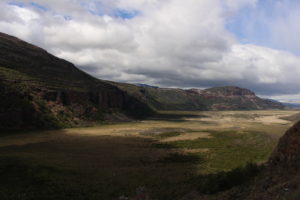
Although it was beautiful, and we spent days that would usually be spent in a classroom splashing through rivers and looking at birds; noting the presence of cows every 250 meters on an active farm only feels especially useful to a point.
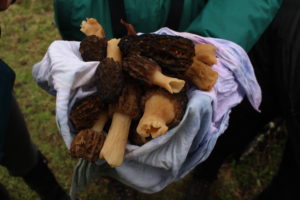
Following that first set of surveys, along with a day spent indoors due to weather (a crucial part of any Patagonian expedition), we had one day left to survey the river valley leading up to the Glacier Mayer. The data started off similarly, regular signs of livestock and burning criss-crossed our trail. Although I was hiking happily, my expectations of huemul data had bottomed out. But there were early signs that something about that day was maybe going to be a little more magical than the rest. Heading towards the glacier took us through old growth forest, among the scrub and downed trees we started to find morel mushrooms that had sprouted after all the rain. A few mushrooms turned into handfuls and those of us with less data to collect had another treasure to look for between the burnt stumps and cow patties.
As we got further into the patches of Lenga trees, people had started to notice large holes scattered throughout the tallest trunks. Although the land could be considered to be disturbed due to the invasive ground cover and the clear signs of burning, neither of these factors prevented this section of the valley from being the perfect habitat for the Magellanic Woodpecker. And sure enough, a few steps and mushrooms later, a distinct pecking could be heard up in the canopy. Magellanic Woodpeckers are visually stunning; their bright red heads and black and white wings are hard to miss, and this one was no exception. There had been no expectation to see one of these birds, listed in Chile as vulnerable. Yet here it was, bashing its head happily against the moss-covered wood.
Our adventure continued onward, and five more kilometers passed, scrambling over downed trees and walking along the aptly named Río Azul, a bright blue river that runs off the Glacier Mayer. By the time we finished our survey, we had reached the bottom of the glacier’s valley and the weather, in celebration no doubt, had turned to 40-something degrees and heavy rain. Although there was the option to go up the ridge and see the glacier, this time the desire to be warm and dry won out and I joined the other few who had started the hike back. Slipping 8k back over the trail we had taken, my thoughts were once again focused more on cold fingers and the muddy path than everything around us. In that moment I was definitely more sopping wet college student than intrepid and eager field scientist. Upon reaching the quincho, Mikkel Sawyer and Cristoff Zweifel, who had decided to shorten their time spent in the rain and run ahead, met us with news of a crazy turn of events. On their jog back they had run into a Geoffrey’s Cat, a small predator often found far away from humans and definitely a point of interest for future conservation. Between being inside, the woodpecker, and news of the Geoffrey’s cat (which we were insistently and repeatedly reassured wasn’t just a big feral cat with spots), the day seemed like more than enough of a success when lo and behold, the rest of the group returned. The first thing out of everybody’s mouth as they walked in the door, dripping and shivering, was news of the expedition’s equivalent of a unicorn. Up on the ridge towards the glacier, they had in fact, seen a huemul. Not just any huemul, but a healthy adult male with a straight set of antlers, indicating that local populations had potentially escaped the genetic mutations that lead to antler malformation. And that was that, folks: four days of grumbling about cow poop and then in less than ten hours, we had encountered three species whose names are buzzwords in Chilean conservation. It appears that my doubts hadn’t impacted reality; yes the land was disturbed, and conservation or restoration going forward has a host of land use impacts to address. But, despite all of that, the ecosystems of Entrada Mayer seem to have found a tentative balance of the wild and the developed. Within those gorgeous 4000-plus hectares, there is space enough for human livelihood to coexist with at least some level of wilderness suitable for a promising range of species. In addition to fond memories of mushrooms, woodpeckers, and getting the chance to witness Marco’s stewardship and care for both the land and his lovable working dogs; I have a greater appreciation for what conservation can look like and where it can happen. I’ve also received the much needed reminder to never underestimate mother nature, and now know that a little cow poop (or in this case a lot) doesn’t make it any less of an adventure, especially in a place as magical as Patagonia.