
Grace, April, Cal, and Finn appreciate the view from the top of a mountain in Horidol-Saridag SPA (Photo by Rebecca W.)
by Mikayla Call, of SUNY ESF
Hello from Mongash Camp!
This past week has been full of research! Since arriving in the Darhad Valley, most of our field work has been centered on setting up a camera trap grid within Horidol-Saridag Strictly Protected Area (SPA). Over the next few months, these cameras will be used to monitor the wildlife populations that call the SPA home. The last day of camera trap setting was one with many memories. We split up into two groups in order to set the last six camera traps (three cameras per group!). Each group had to hike over 30 km in order to finish setting their cameras, which meant that we all had a full day of hiking. My group (along with Rebekah, Alyssa, and Lauren) mostly hiked along the riverbed of the Mongash River, setting our cameras up in drainages along the river. We were lucky enough to see a lot of cool wildlife along the way, including plovers, a juvenile woodpecker, wolf pup tracks, and baby kestrels! Along our way back, we ran into Nyam-ochir, the ranger who has accompanied us as we set up camera traps in the previous weeks. We were excited to tell him that all of our camera traps had been set, and it was fun to run into a familiar face, despite being in the middle of the wilderness.
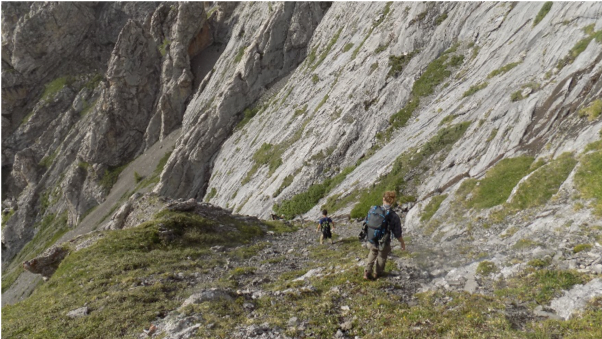
Finn and Cal navigate down from the top of a mountain after setting a camera trap (Photo by Grace S.)
Group two went on what they are now (lovingly) calling the “marathon hike”, reaching 2750 m in elevation and travelling close to 38 km! In order to set one of their camera traps, they had to climb up the side of a mountain. “The views made the struggles of climbing up the mountain so worth it,” Grace said. Of course, what goes up must come down – everyone made it back safely and they all seemed proud of their accomplishments. Needless to say, both groups came back hungry and tired that night. But the best part about the last day of camera trap setting is the feeling of being done. We accomplished a lot, setting over 25 camera traps in the backcountry in just two weeks. Not only did we learn a lot about how to properly set up a camera, but we also learned a lot about ourselves as we pushed ourselves over difficult terrain. Unlike in a national park in the U.S., Horidol-Saridag SPA does not have any trails (unless you include game trails!). I think we can all agree that we’ve accomplished a lot in just the first few weeks here.
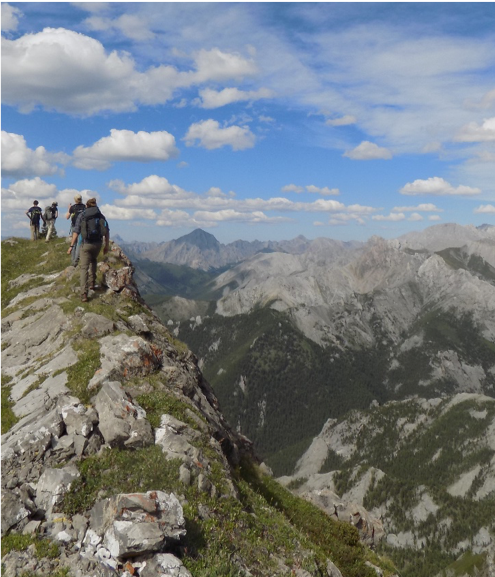
Cal, Rebecca, April, and Finn hike across the top of a mountain (Photo by Grace S.)
The rest of our week was made up of waterfowl surveys. The term waterfowl refers to birds that are often associated with water, such as ducks, cranes, swans, and geese. To our knowledge, no data has been published in western scientific journals for waterfowl in the Darhad Valley, giving us the opportunity to contribute to the understanding on what waterfowl use the lakes in the Darhad Valley as habitat. Multiple species listed by the International Union for the Conservation of Nature (IUCN) as threatened through critically endangered are expected to use the bottom of the Darhad Valley for habitat. Our goal was to survey to lakes so that we could (1) know what species of waterfowl were present in the bottom of the Darhad Valley and (2) estimate the densities of some of those species so that the Rangers and local governments could use those densities for future monitoring. That meant that our research was very important and applicable! It was a great feeling to be able to contribute to that kind of research and as a bird person, I enjoyed looking at all of the different species of waterfowl.
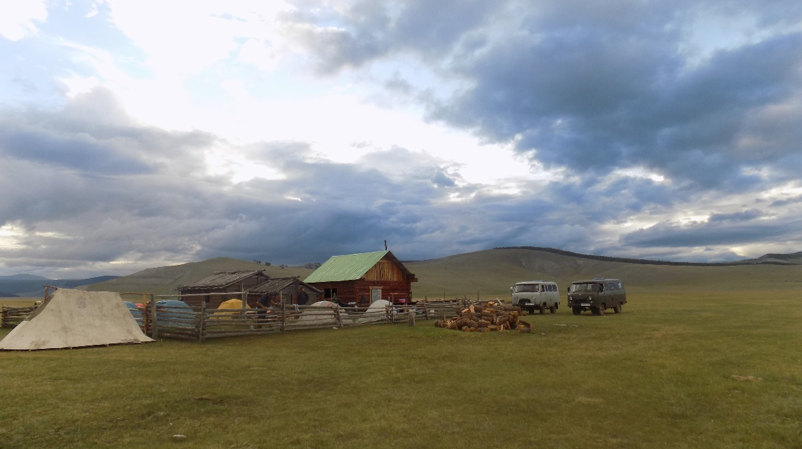
Our camp at Battogtukh’s cabin (Photo by Grace S.)
Our surveys took place in the bottom of the Darhad Valley, to the north of Mongash Camp. This meant we got to travel to the Renchinlhumbe and Tsaagaanuur soumes in the central part of the valley, where we set up camp in the front lawn of Ranger Battogtukh’s home. It was exciting to see a different part of the valley, and the flat, grassland habitat was different from the mountainous terrain around Mongash Camp. During the three and a half days that we were there, we surveyed a total of 60 lakes, counting about 5,000 individual birds on the lakes!
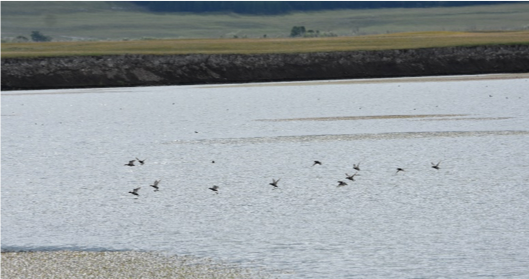
A flock of Goldeneye and Tufted Ducks takes off from one of the lakes that we surveyed (Photo by Chris S.)
The biggest take away for me from this research experience? It’s difficult to count little, bobbing duck heads that are close to a half kilometer away from you on a lake. Goldeneyes look similar to Tufted Ducks unless you can focus a shaky scope on them, and even then it’s difficult to determine the difference unless you can really make out subtle differences in the shape of their heads. You also eventually get tired of counting 279 Goldeneyes in a raft (a gathering of ducks) on the lake—sometimes you lose track and you have to start over again, other times ducks will enter of leave the group in the middle of you counting. It can be frustrating, but every time we saw a new species, it was exciting! Over the four days that we spent doing waterfowl surveys, we all seemed to get pretty good at identifying various ducks, cranes, and swans, and shorebirds. We also started to notice patterns in the distribution of birds and the way the land is used. For example, one of our later lakes—known locally as “White Horse Lake”—was once known for being home to hundreds of birds. We were looking forward to surveying the lake, hoping that we would find a wide variety of species on it. To our dismay, we only counted a few Great Cormorants and the occasional loon. That’s when Battogtukh told us that the lake had been overfished in the past and still had nets in it currently. We eventually found more of the birds concentrated around inflows from the river, where food may have been entering the lake.
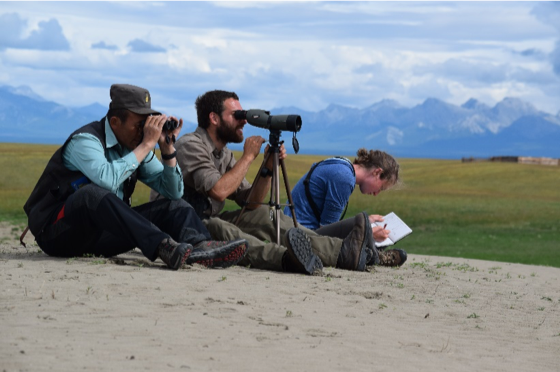
Battogtukh and Chris count waterfowl on a lake while I record the data (Photo by Badmaa D.)
We didn’t only see waterfowl during our waterfowl surveys, though. A highlight from one of our first days of surveying was when Battogtukh showed us an eagle nest that he had been observing for years. The eagles using this nest, he said, has successfully raised two chicks per year for the past four years. We were able to approach the nest and get a good look at the two young white-tailed sea eagles in it. For many of us, this was the closest we had ever been to such large eagles. It was amazing to sit quietly in the grass with the Ranger as we watching the mother eagle call to her babies and swoop in to feed them. This was only the first of many nests that we got to see during our time surveying the waterfowl.
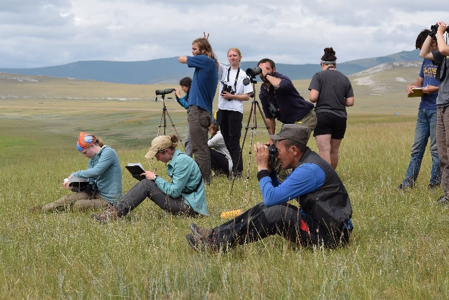
Surveying the lakes for waterfowl (Photo by Badmaa D.)
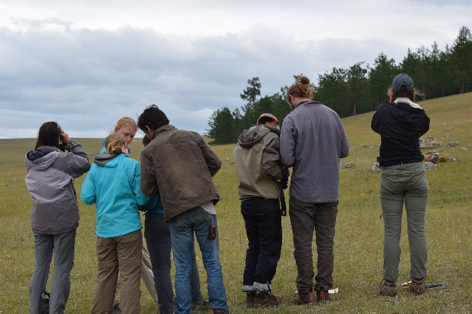
The group observed the eagle nest from afar. (Photo by Mikayla C.)
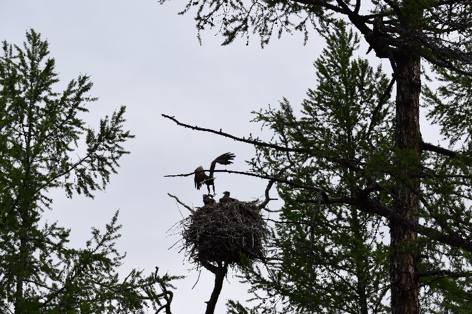
Momma eagle swoops in to give her babies a ground squirrel
(Photo by Mikayla C.)
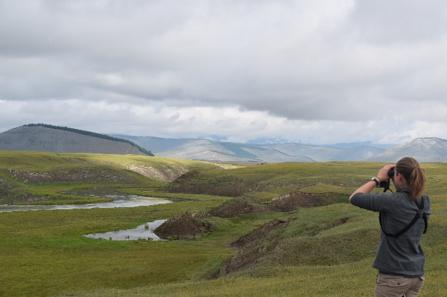
Surveying the lakes for waterfowl (Photo by Badmaa D.)
On the last day of surveys, Rebekah and I got to experience a traditional Mongolian dinner with a family after we stayed late to finish surveying some lakes. On our way home from the last surveyed lake, our driver and Battogtukh told us that we were going to stop to congratulate another Ranger on earning an award from the Mongolian government for his 20 years of work with the Environmental Ministry. Of course, if you’re stopping to visit someone’s home in Mongolia, that means you also have to come in for some milk tea and aarl (dried yogurt). If the family is cooking dinner, then you also have to stay for the meal. And that’s how Rebekah and I got to experience organ meat for the first time in Mongolia! Dinner consisted of the lung, liver, kidney, hearts, tongue, blood, and intestines of a sheep. Believe it or not…it was pretty good! Both of us surprisingly enjoyed the meal. “I think my favorite organ was pretty solidly the heart,” Rebekah said. I think I have to agree that the heart was the best tasting part of the meal.
Overall, this week was full of amazing memories. We saw a lot of wildlife, learned a lot about wildlife surveying, played some pranks on instructor Chris, got only a few bruises from bumping along in a Furgon, bought some souvenirs from a local craftsperson, and ate a lot of summer camp (a type of wafer cookie) and chocolate bars. The only slight hiccup that happened was when we lost a jar of peanut butter. Camp may never be the same without it and the investigation on its whereabouts is ongoing.

Buying souvenirs from the “traveling mall” (Photo by Mikayla C.)
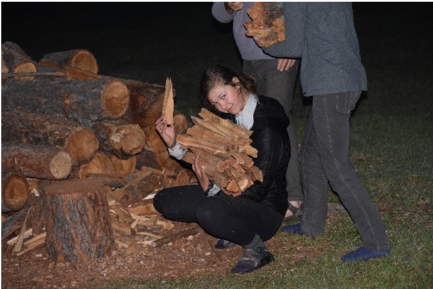
Grace helps haul wood indoors so that it doesn’t get wet during a storm (Photo by Badmaa D.)
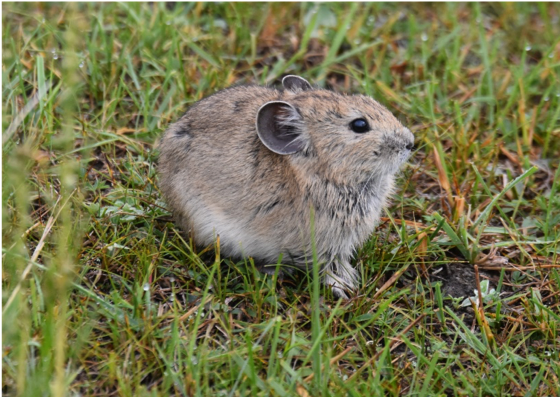
A Daurian Pika outside of Battogtukh’s home (Photo by Chris S.)