
By Alyssa Cote (of University of Vermont) and Finn Townsley (of Westminster College)
We arrived in Ulaanbaatar (UB) around 11pm on June 26th, where, exhausted from a full day’s travels, we drove straight to the hostel and went to sleep. The next morning, we experienced our first Mongolian meal: fried dough, yak cream, local jams, and bread. We then explored the city, heading to Sukhbaatar Square, a grand plaza where the parliament building of Mongolia is located. The statue of Sukhbaatar, a Mongolian revolutionary hero, stood in the middle of the square. We also saw the statue of Chingis Khan (Genghis Khan) in the main government building, surprisingly one of the only statues of Chingis Khan in the country. From the square, we headed west to a Buddhist Monastery compound to learn more about the religion. We were able to take part in the spinning of the prayer wheels: a row of wheels which, when spun, released prayers of peace and understanding as well as various community prayers. Inside the largest building of the compound was a four-story tall Buddha, one of the largest in the country. We went out to a traditional Mongolia restaurant, heavy on fried dough and meats and animal fat, accompanied with noodles and sides of potatoes, beets, and cabbage.
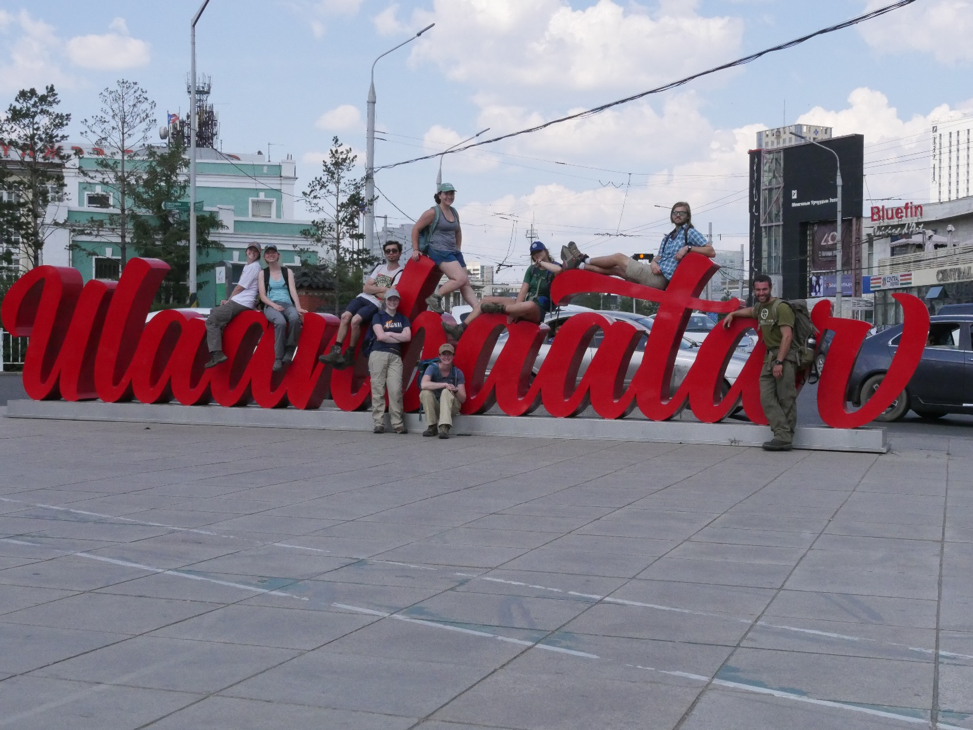
Hanging out in the capital city.
We also visited the National Museum of Mongolia, co-curated by the American Smithsonian, which contained many notable and historic Mongolian relics, numerous animal’s ankle bones, and traditional and ancient garments. We were all impressed by Mongolia’s long history and ever changing clans and groups controlling the area. Another interesting relic was the oldest known stone tablet containing Mongolian script.
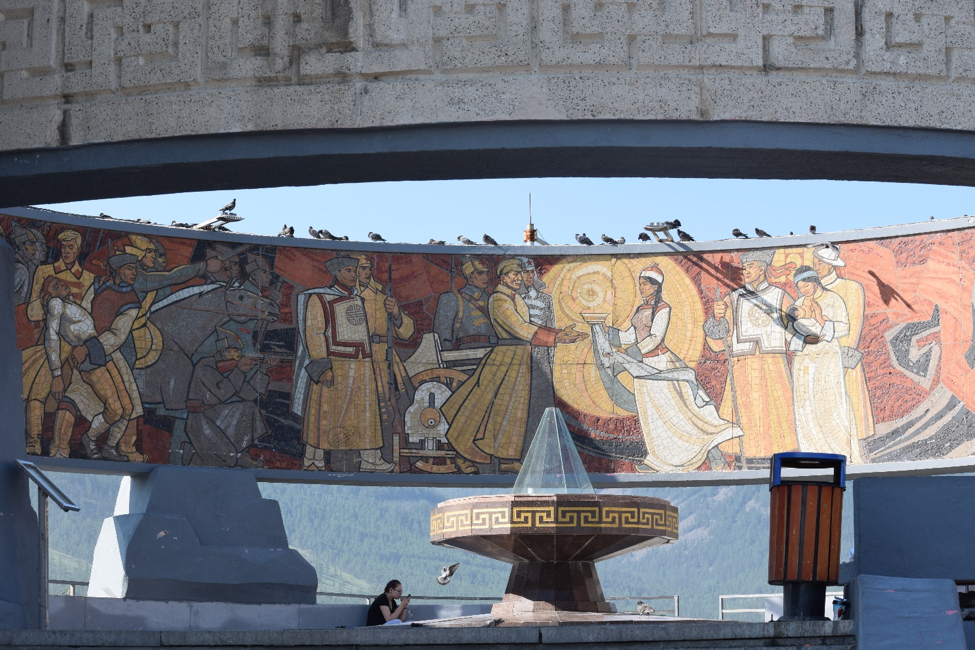
Looking South at the Zaisan monument.
On our last day in UB, we hiked above the city and to the Zaisan monument, a huge monument on top of a hill just outside of the city, which commemorated the country’s communist history and included murals of the cooperation of the Soviet Union and Mongolia. Following the trail further up, we hiked to an overlook of UB and had our first look at some of the native birds, including kestrels, ravens, and pine buntings. Along the trail, we were able to identify yellow scrophs, purple asters, buttercups, poppies, and other flowers that we could narrow down to the pea family. It was nice to have a break from the busy city, and to see a view of the valley. We all appreciated the fresh air and quiet the hike provided.
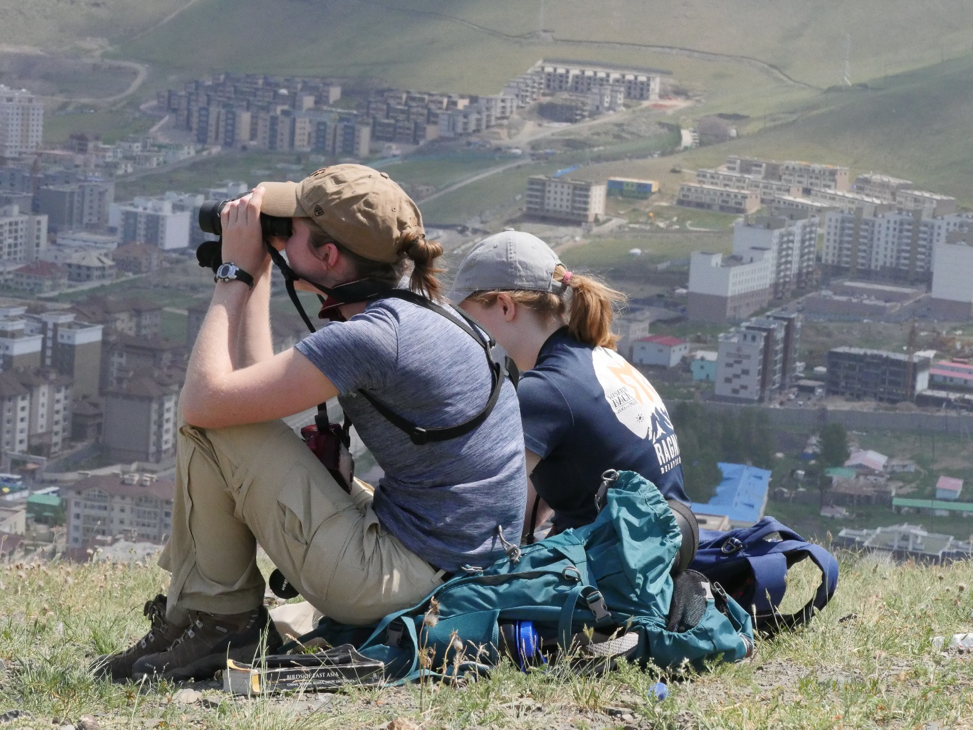
Mikayla and Rebekah observe circling kites atop Zaisan.
Our mode of travel out of UB was a bumpy 11 hour overnight train, headed northwest to the town of Erdenet. Each cabin consisted of 4 beds attached to the walls. In the morning, we continued the same direction in a van headed for Muren, stopping frequently for herds of livestock in the middle of the road. We spent the night outside of Muren in a ger camp. A ger is a traditional Mongolian countryside home, similar to a yurt. It is portable and can be set up in about 2 hours. Adjacent to the camp was the nation’s largest collection of Deer Stones: large stones standing upright with depictions of flying deer carrying the person’s soul up to the sun. The stones are roughly 3,000-4,000 years old and were only designated as a protected area in 2013. Next to the deer stones were burial mounds, khirigsuurs, which are large piles of rocks which commemorate significant events.
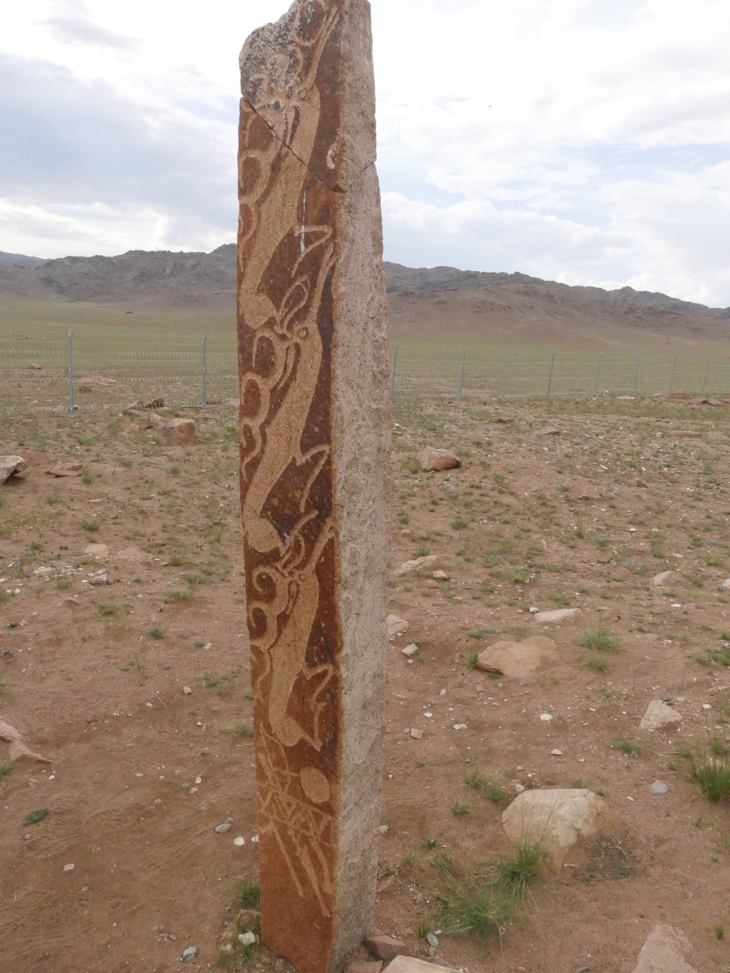
A Deer Stone outside of Muren.
The next morning, we boarded a furagon, a vehicle first designed during WWII by the Russian military and still in production today, excellent for traversing the rough Northern Mongolian landscape. We stopped frequently on the road due to our engine overheating – a problem that often accompanies a furagon journey. Luckily, our driver doubled as a mechanic and whipped out his tool kit, exchanging overheated nuts and bolts with his own from his tool bag, and got us back on the road. At one point in the journey, the back door opened and it took a couple tries to get the driver’s attention due to the language barrier. We almost lost a lot of our stuff! The drive lasted only 8 hours, thanks to the driver’s knowledge of the area and shortcuts cutting across prairies.
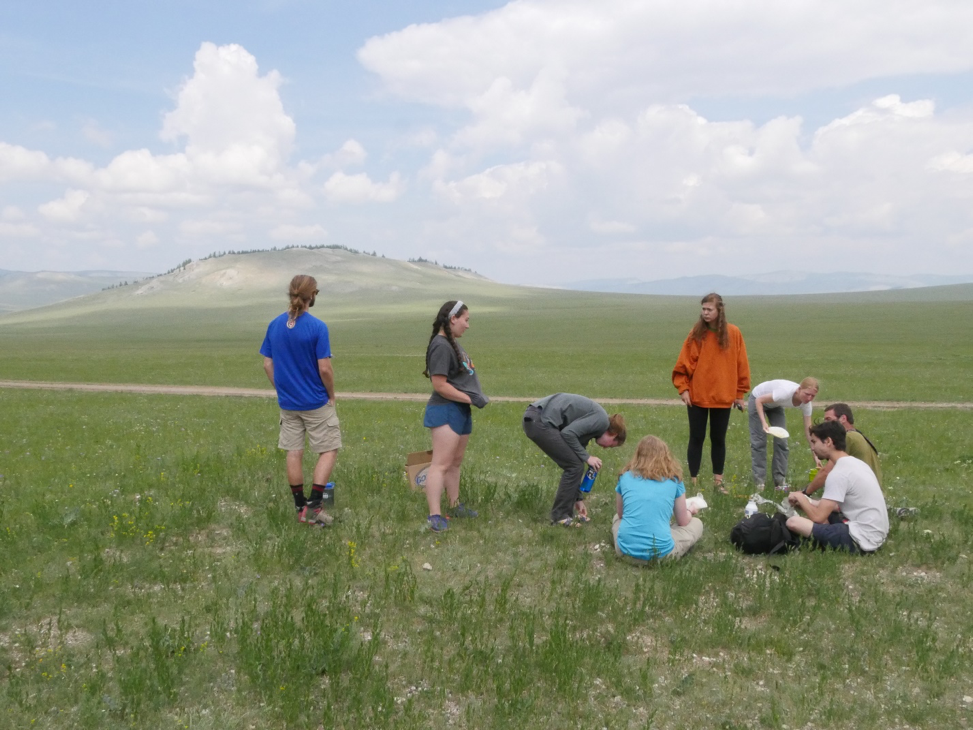
Lunch break on the beautiful meadow on the way to the Darhad Valley.
After piling out, bruised from the bumpy ride, at Mungash base camp (outside of Ulaan-Uul), we set up our tents, and unloaded three van’s worth of supplies. We spent the next day setting up camp: collecting firewood, fetching water, building a latrine which consisted of a 3-foot hole with two planks to squat on and a tarp for privacy. A hundred meters away, we set up a shower stall.
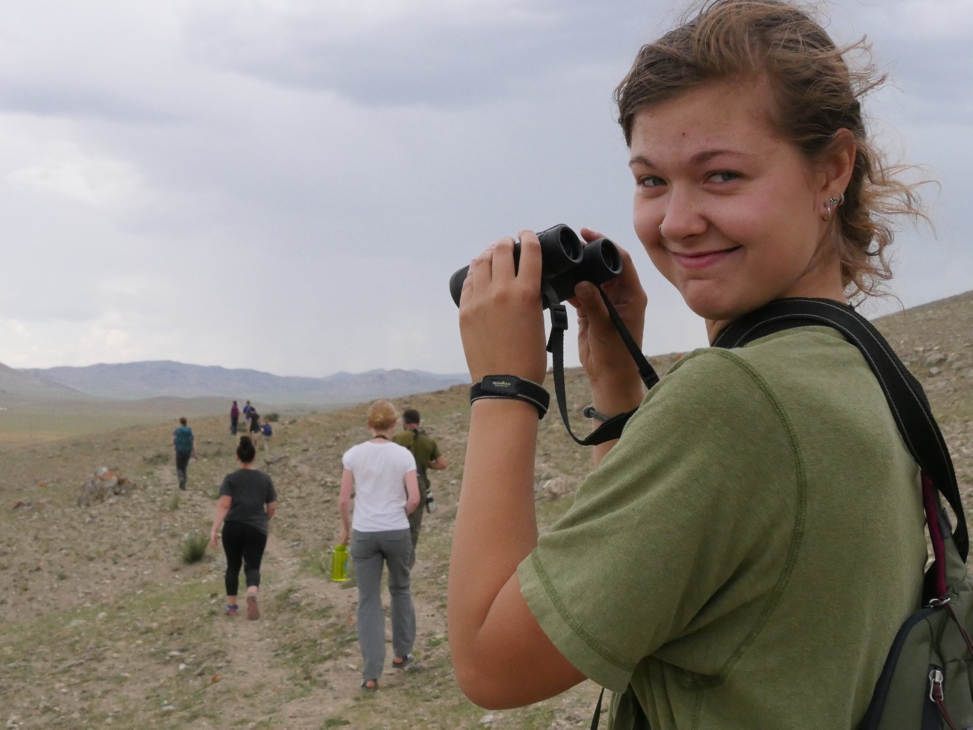
Grace searches the valley near the Deer stones for kestrels.
As we entered the Darhad region, we passed huge cone shaped rock piles, called ovoos. It is traditional to walk clockwise around the piles and to add a rock if you feel lead to. It signified our welcome into the Northern region of Mongolia.