
December 7, 2012
By Sam Feigenbaum (Carleton College ’14)
Somehow finals have come and gone already!
Back in West Winds last Sunday after our abbreviated second round of bird surveys, folks got to work immediately. A busy week loomed: research papers on the bird surveys due on Thursday, restoration plans and Grinnell Journals due on Saturday, a Conservation Biology paper due on Monday, a Humans and the Environment Paper due on Tuesday, a presentation of our bird survey findings to Conservación Patagonica on Saturday night, Conservation Biology and Humans and the Environment exams on Monday, and a Natural History practical on Tuesday. Even though we worked laid out in our tents or in the grass (not exactly your typical library!), it sure felt just like finals week back home. A whole lot of work to do and not a whole lot of time to get it done.
Our first task to complete was our bird survey research papers, to be written by three groups. Adele led the entry and analysis charge, entering all the raw data we recorded in the field into Excel, and arranging the data to allow groups to easily navigate through the information. Using this data, we measured bird biodiversity and, when possible, abundance at the lagoons we surveyed, information Conservación Patagonica had specifically asked for. On top of this, each group used their papers to answer questions they found intriguing: Was there a correlation between the number of different habitat types and bird biodiversity at a lagoon? Was there any difference in biodiversity between the two phases of the bird surveys? Did lagoons with mudflat habitat have higher biodiversity than lagoons without mudflat habitat? While we plugged away on our papers, Adele, Colin, and Matt also worked on a bird survey Powerpoint summarizing our findings for our presentation to Conservación Patagonica on Saturday night.
With the bird survey research papers finished on Thursday, we turned our attention to our restoration plans and Grinnell Journals. Our restoration plans were to be written in two groups; each group had been assigned the task of preparing a specific restoration plan for an intensively grazed patch of land just off the main valley road. Scott could be heard proclaiming the benefits that mycelium brings to degraded soil, while Heidi reminded him again and again that their “restoration budget” was not unlimited! In between group meetings to hash out our restoration plans, we put the finishing touches on our Grinnell Journals. Kellen could be seen slaving over his species accounts, while Ingrid flicked through her already hefty journal, colored pencils at the ready, sketching away.
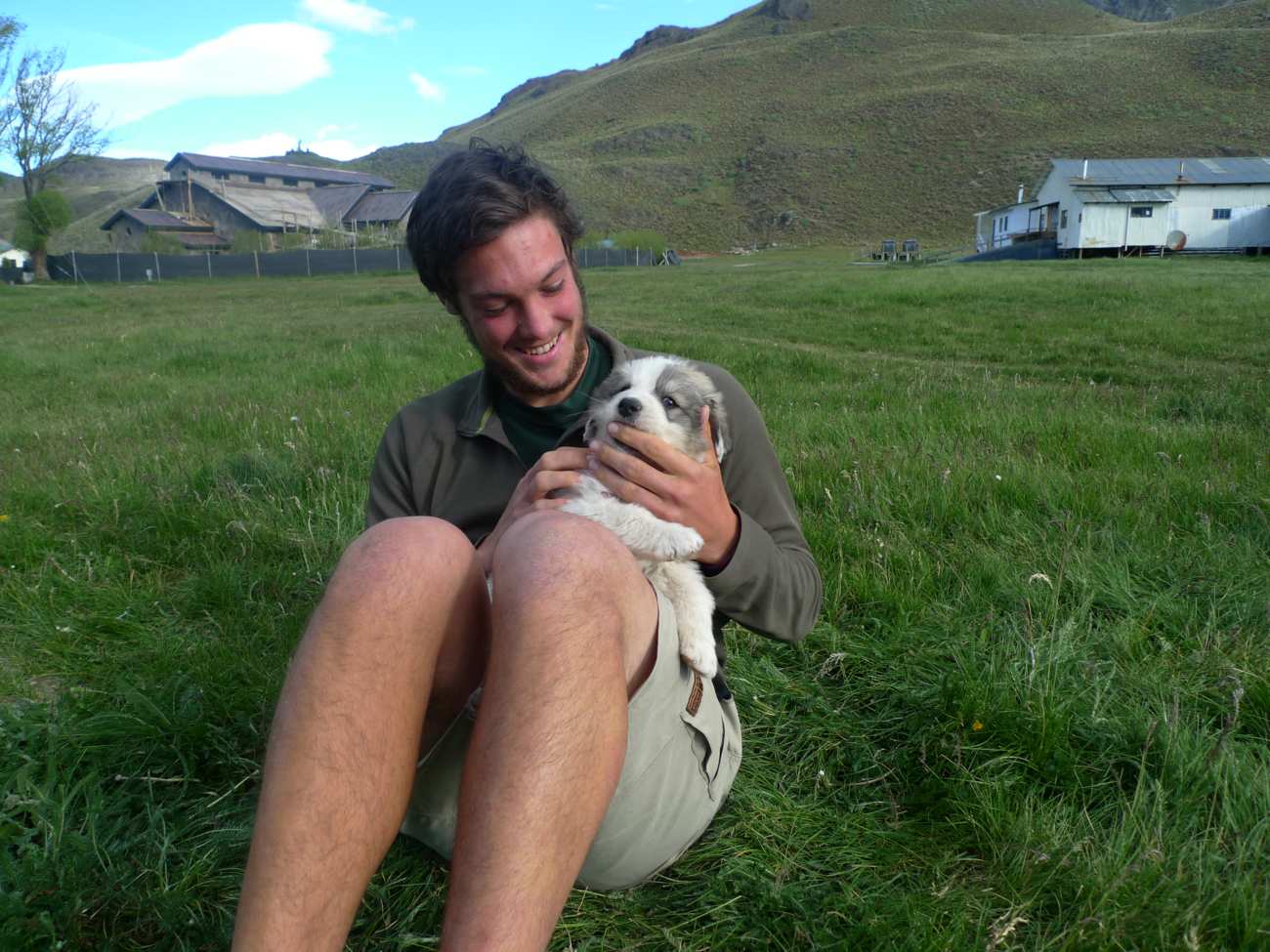
Looking for a reliable power source to keep our computers alive (our trusty solar charger back at West Winds was suddenly not so trusty anymore), Berrett and I tromped over to Conservación Patagonica headquarters. Along the way, we stopped to play with nine adorable Pyrenées puppies (Conservación Patagonica breeds Pyrenées to sell as guard dogs to local livestock ranchers). Upon hearing this, Kelly, who thinks no dog too mangy to pat, pronounced herself overwhelmed with jealousy.
Saturday night–– our restoration plans and Grinnell Journals turned in that morning–– the whole group, showered and cleaned as best we could, headed over to the Conservación Patagonica restaurant. We were to present our bird survey findings later that night and were being treated to dinner beforehand. What a treat! Ceramic plates, real utensils, chairs with backs, and the warmth of inside.
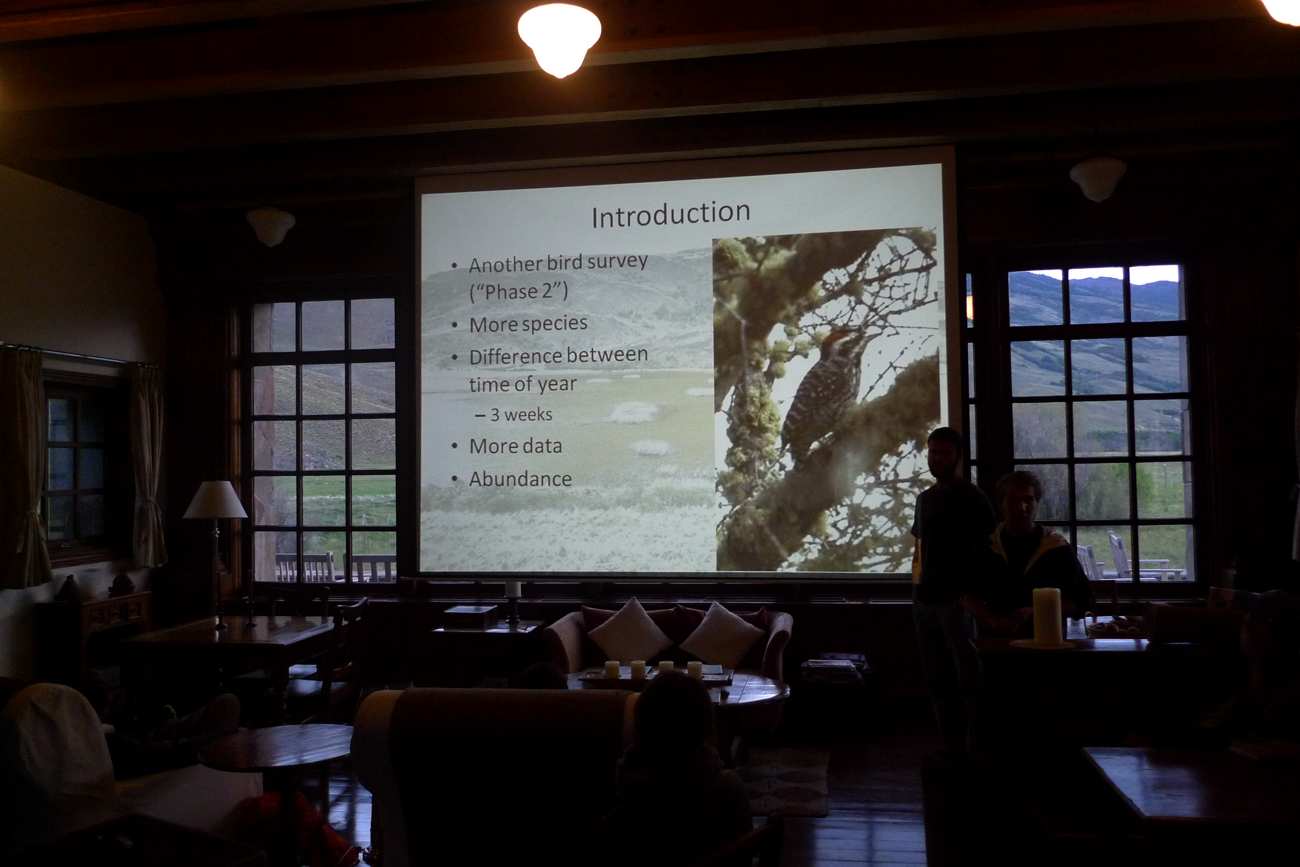
Our bellies full, we all made the short walk to the lodge for the bird survey presentation. To an audience of Conservación Patagonica biologists, staff, and volunteers, Adele, Colin, and Matt presented our findings, highlighting our results and the difficulties of carrying out scientific work in the wet and cold. On the very last slide, they included a picture of what we think was a Lake Duck, a species never before seen in Valle Chacabuco!
Back at West Winds on Sunday, we kept at it, writing out our papers and compiling study guides for our exams. A very full day of work!
Monday morning, exams began. First up was Conservation Biology. It was cold and rainy outside and some of us decided that we’d rather take our exams in our tents. Never again, I’m fairly certain, will I take an exam in my sleeping bag!
The exam passed in a flash as we scribbled out all we knew on island biogeography, maximum sustainable yield, ecosystem services, and much more. After a quick lunch, we were back in our tents for the Humans and Environment exam, explaining the pros and cons of concepts like sustainable development, community based conservation, and traditional ecological knowledge. By mid-afternoon, we were all through. That night we studied up on bird vocalizations, flower identification, mammal behavior, and the particulars of the Valle Chacabuco ecosystem for the Natural History exam the next morning.
For an exam, the Natural History practical Tuesday morning was quite a bit of fun! Moving from station to station, we identified scat, took bearings with our compasses, identified bird calls, and explained the best ways to tell similar looking ducks apart. With the practical through, our work for the term was finished!
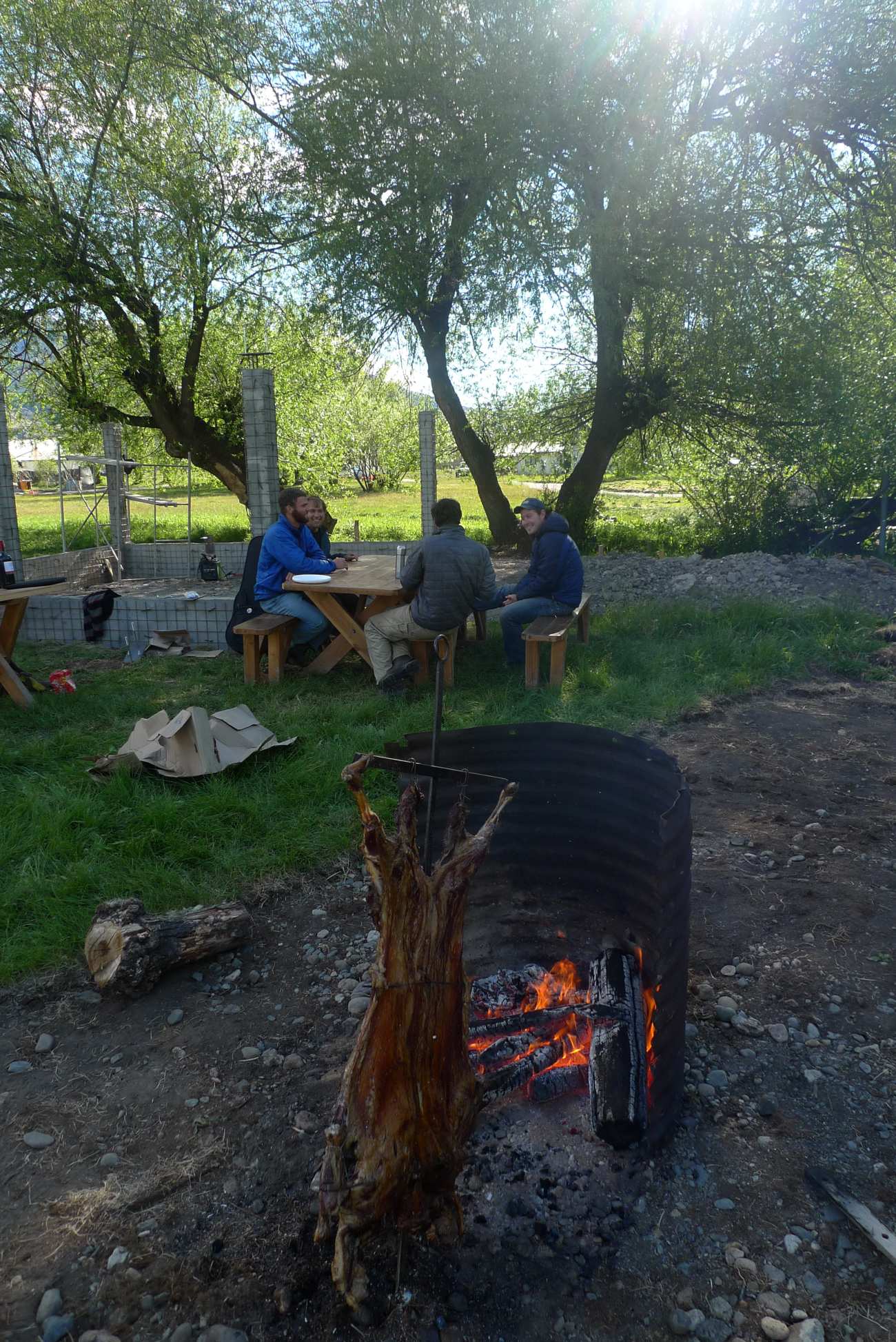
That afternoon Christian, the Conservación Patagonica biologist, threw us an asado to thank us for our work in Valle Chacabuco. We munched on freshly roasted lamb, potato salad, and guacamole, looking forward to our last week in Patagonia: an excursion to the fjords and mountains!