
November 24, 2012
By Heidi Anderson (Macalester College ’14)
Despite a gloomy forecast, we woke up to sunshine Tuesday morning, and prepared for a day of November bird surveys. We crawled groggily out of our tents at 5:30am and had already done our morning inventory, cooked a leisurely breakfast, and packed up camp by 10am. From there we headed east to Lagoon 21, a long, linear, marshy lake on the valley floor where we were greeted by clouds of huge, blue dragonflies. That afternoon was mostly devoted to napping and academics. The wind strengthened throughout the day and menacing clouds closed in from the west. By dinner it became clear that although a few days late, the predicted storm had arrived (running on Chilean time) and had scared all but the bravest birds into hiding. Horizontal rain and high winds forced the evening survey to be canceled, leaving us a much-appreciated free evening spent playing cribbage and chatting through tent walls.
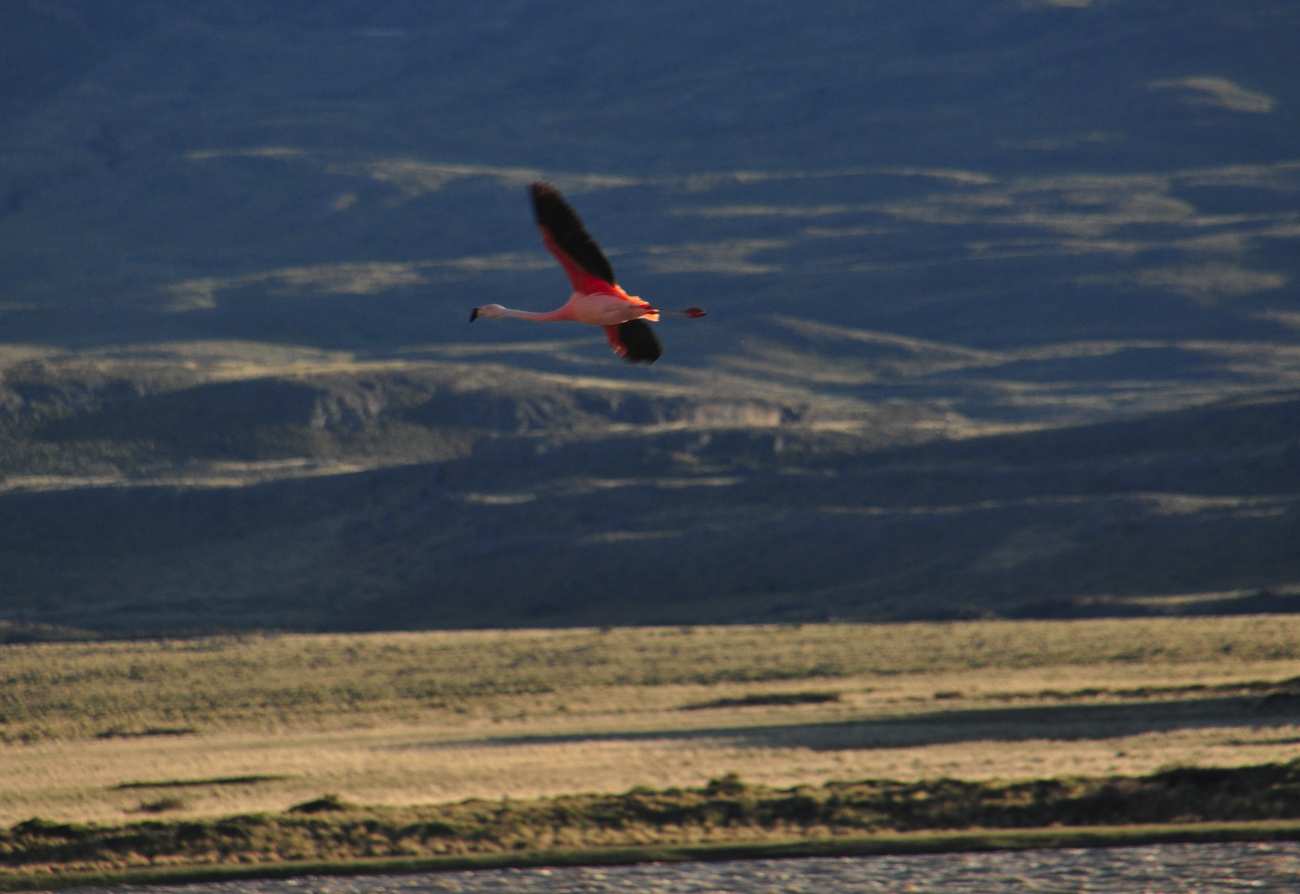
Just before the weather hit, Sam, Berrett, Kelly and I ventured out to explore the area and hunt for guanaco skulls. We walked into an unreal landscape, as if a snapshot of a fairytale or Disney movie. A herd of over a hundred guanacos were grazing in the marshy grassland just in front of us and several flamingos stood in the water to our left. The last bit of sun lit up the snowy mountains in the background and a full, bright rainbow arced over the entire scene. Of course this paradise couldn’t last forever, and the rain started soon after we turned back for camp. Luigi, the park restorationis and a member of the puma-tracking team for Conservacion Patagonica, gave us a lift back and the rain pattered on our tents for the rest of the night.
Bird surveys were on the next morning thanks to an unexpected break in the weather, but were cut off an hour short when it started to snow. It seemed futile to stick around and hope for blue sky, so we crammed into the trucks and drove all the way across the valley to Lake Lilliana on the Argentina-Chile border. The mountains had in fact broken up the clouds, but the wind was absurd. We set up camp next to a small rock face in an attempt to get some kind of shelter, but it was merciless. Tents were literally flattened to the ground, poles bent, and tornadoes of mist were whipped up and traveled along the top of the lake. Best estimates of wind speed are in the 50s to 60s (miles, not kilometers, per hour!). In any case, the birds were tough, so we went out to survey that evening as usual. Since our last visit, hundreds of delicate little wildflowers had popped up, hiding in and around the bunch grasses. There were also dozens of little ducklings and goslings trailing in long lines after their parents, often being mostly submerged in the choppy water. After a beautiful and chilly sunset, we piled sleepily into the tents that still stood, the few remaining homeless smushing into the trucks with sleeping bags and pads for a surprisingly comfortable night’s sleep.
The next morning came all too early, but at least a little warmer. The lake was covered in pink mist and although it was sunny, snowflakes blew over from the evident storm in the nearby mountains. We headed back west soon after our survey, making for a campsite with a small shelter and wood stove. On our drive we saw yet another rainbow and several fluffy, awkwardly long-legged guanaco babies. Right before we reached the campground, we pulled over to watch as over sixteen condors soared low over us and perched on the rock face directly adjacent. None of us had seen such a large group of these birds before or so close! The rest of the day was devoted to academics, a rustic Thanksgiving meal (pasta or rice in a tupperware) and an evening bird survey.
On Friday the 23rd, we dragged ourselves out of our sleeping bags even earlier than usual to account for a short but steep hike to lagoon 4. Fat snowflakes started floating down, and after an hour of surveying, we once again had to call it off. At this point we were forced to reconsider whether or not we would be able to survey our last two lagoons as planned. One of our trucks was steaming out the vents when confronted with a big hill, our water filters were starting to clog, and the weather was not showing any signs of improving. The leaders wisely decided it would be best to head back to Los West Winds Campground, and after a long breakfast we packed up the trucks, singing made-up Patagonian parodies of Christmas songs throughout.
We were all grateful to be back at camp. We slept, did laundry, and the next morning had a “Thanksgiving brunch” to make up for the lackluster meal we had on the actual day. The picnic tables were formally set with all of our mix-matched dishware and old glass jam jars filled with dandelions as centerpieces. Adele made three types of pancakes from scratch (chocolate, plain, and blueberry) and there were vegetable omelettes and peach juice to go around. YUM.
Good food and lots of sleep. Los Westwinds, its good to be home.